

ARCHERY
UPCOMING EVENTS & COMPETITIONS
30 OCTOBER–1 NOVEMBER 2026
Swiss Open Lausanne
Lausanne, Switzerland
An open-entry indoor tournament welcoming recreational and elite recurve and compound archers at the World Archery Excellence Centre.
20–22 NOVEMBER 2026
GT Open
Strassen, Luxembourg
An international Indoor World Series event where registered recurve and compound archers can compete alongside leading professionals.
4–5 DECEMBER 2026
Rio Indoor
Rio de Janeiro, Brazil
An open-entry Indoor World Series competition designed to include recreational participants as well as experienced international archers.
Competition dates and arrangements may change. Confirm details with the event organiser before attending.
ARCHERY
Archery is a precision sport built around control, posture, calmness and repeatable technique. The aim is simple: shoot arrows from a bow and place them as close as possible to the centre of a target. The difficulty comes from everything that happens before the arrow leaves the string. The archer must manage stance, breathing, grip, draw length, anchor point, release, sight picture and follow-through, while staying mentally steady under pressure.
Modern archery ranges from traditional barebow shooting to Olympic recurve, compound archery, field archery, indoor target archery and para archery. Some formats are highly technical, with advanced sights, stabilisers and release aids. Others strip the sport back to instinct, body alignment and feel. It can be practised recreationally, competitively, indoors, outdoors, individually or as part of a team.
Archery rewards patience more than brute strength. A beginner can learn the basics quickly, but serious progress depends on consistency, coaching and disciplined repetition. At elite level, the sport becomes a contest of millimetres, where one poor release, gust of wind or lapse in concentration can decide a match.
ARCHERY RANGE

An archery range is usually a clear, measured shooting area with a fixed shooting line at one end and targets placed at set distances downrange. In target archery, the archer stands behind the shooting line and fires towards circular targets divided into coloured scoring rings. The centre ring scores the highest, with scores decreasing as arrows land farther from the middle.
Outdoor target ranges can use long distances, especially in recurve and compound competition. Olympic recurve archery is commonly shot at 70 metres, while compound target archery often uses 50 metres. Indoor archery is much shorter, commonly around 18 metres, but the smaller target faces make precision just as demanding.
Field archery uses a different environment. Instead of shooting on a flat open range, archers move through a course with targets set at different distances, angles and elevations. Some targets may be uphill, downhill, partly shaded or placed among trees. This makes judgement, terrain reading and shot adjustment more important.
A safe range has a clearly marked shooting line, waiting area, target line, side boundaries and a secure overshoot zone behind the targets. Nobody crosses the shooting line while shooting is active, and arrows are only collected when the range is declared safe. The layout is simple, but the safety discipline is strict because arrows travel fast and carry enough force to cause serious injury.
BOW, ARROW AND COMPETITION EQUIPMENT
The standard competition bow in modern target archery is usually either a recurve bow, a compound bow, or a barebow, depending on the event. The bow is not just a curved stick with a string. In competition it becomes a tuned precision system, with the bow, string, arrows, sight, stabilisers and the archer’s body all working together.
Recurve Bow
The recurve bow is the Olympic bowstyle. It has a central riser, usually made from aluminium or carbon fibre, with two flexible limbs attached above and below. The limb tips curve away from the archer, which gives the bow its name. The string is drawn by the fingers, usually protected by a finger tab, and released directly from the hand.
A modern competition recurve normally includes an adjustable sight, arrow rest, pressure button, clicker, stabilisers, dampers, finger sling, arm guard and chest guard. The sight helps the archer aim, the clicker helps control draw length, the pressure button helps the arrow leave the bow cleanly, and the stabilisers balance the bow and reduce vibration. World Archery describes recurve as the Olympic bowstyle and notes that international recurve target archers shoot at 70 metres on a 122 cm target face.
For a beginner, the recurve is usually the best “standard bow” to understand first because it teaches posture, draw, anchor, aiming and release without the mechanical let-off of a compound bow. At higher levels, however, it is extremely technical. A tiny error at release can move the arrow far from the intended point at 70 metres.
Compound Bow
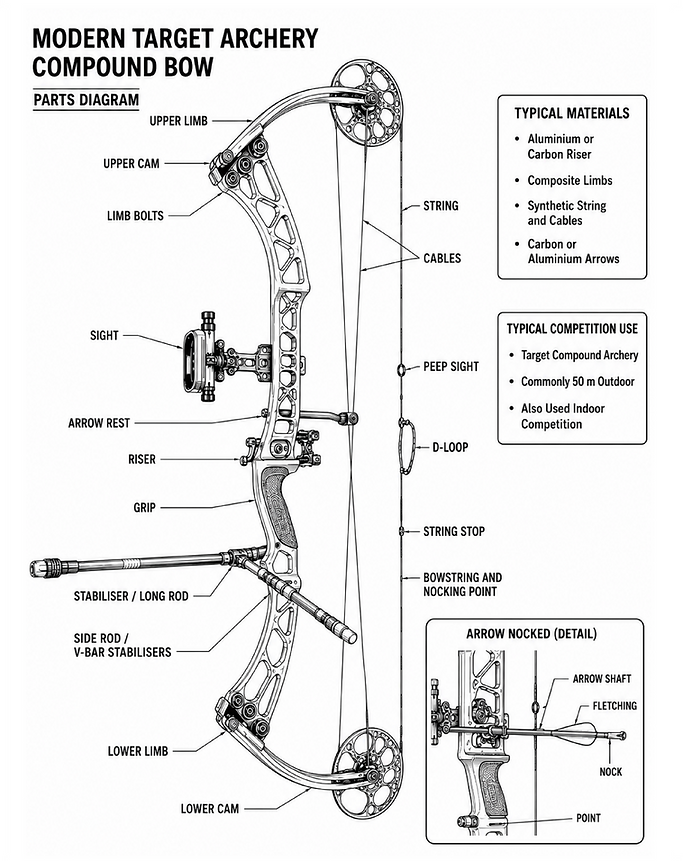
The compound bow uses cams, pulleys and cables to change the force needed during the draw. The archer pulls through the heavy early part of the draw, then reaches a point where the holding weight drops sharply. This makes it easier to aim steadily at full draw. Compound archers normally use a mechanical release aid rather than releasing directly from the fingers.
A competition compound bow may include a magnified scope, sight pin, levelling bubble, stabilisers, blade rest, D-loop and release aid. This makes compound archery highly precise, but not easy. The equipment gives stability and repeatability, yet the archer still has to execute cleanly under pressure. World Archery notes that compound archers usually shoot 50 metres at an 80 cm target face in international target competition, with a smaller 10-ring than recurve competition.
Barebow
Barebow is essentially a stripped-down recurve bow. It uses modern materials, but removes the main aiming and stabilising aids. No normal sight is used, and the bow must not have marks or devices that help the archer aim. The archer often aims by looking down the arrow and using consistent draw, anchor and hand position.
Fixed weights may be allowed, but the bow has to remain within strict equipment limits. World Archery states that a barebow must fit through a 12.2 cm ring when unstrung, and Archery GB’s 2026 rule update clarifies that attachments must not help with aiming or ranging.
Arrows
A competition arrow has four main parts: the shaft, the point, the nock and the fletchings. The shaft is the long body of the arrow. The point is the metal tip. The nock clips onto the bowstring. The fletchings, usually vanes or feathers, stabilise the arrow in flight.
The main arrow types are:
Aluminium arrows are durable, consistent and often used by beginners or indoor archers. They are usually heavier than carbon arrows and can be made with wider shafts, which can help indoors because a larger legal shaft has a better chance of touching a scoring line.
Carbon arrows are light, fast and common in outdoor archery. They hold speed well over longer distances and are widely used by serious recurve and compound archers.
Aluminium-carbon composite arrows combine a carbon outer structure with an aluminium core or similar hybrid construction. These are common at elite level because they offer good straightness, consistency and wind performance.
Wooden arrows are mainly used in longbow and traditional archery. They suit historical or traditional bow classes rather than modern Olympic-style recurve or compound competition.
World Archery’s 2026 target archery rules allow arrows of any type, provided they meet the common meaning of an arrow and do not damage the target face or butt. The maximum shaft diameter is 9.3 mm, the arrow point must not exceed 9.4 mm, arrows must be marked with the archer’s name or initials, and all arrows used in an end must look identical. Electrically or electronically lit tracer nocks are not allowed.
Sights, Stabilisers and Range Finding
Competition archery is strict about what helps the archer aim.
In recurve target archery, a sight is allowed, along with stabilisers, a clicker, pressure button and normal non-electronic accessories. The sight can be adjusted for windage and elevation, but it must not become an electronic aiming system.
In compound target archery, a more advanced sight is allowed, including magnification and a level bubble. A mechanical release aid is also normally allowed. This is why compound looks more like precision engineering than traditional archery.
In barebow, the key restriction is that the bow must not contain sights, marks, stabilisers or attachments that help with aiming or judging distance. The archer is meant to solve the shot through body position, string walking or permitted technique, not through visible aids.
Range finders are the clearest “no” item in most serious competition contexts. In target archery the distance is already known, so a range finder is unnecessary. In field and 3D archery, where judging unknown distance can be part of the challenge, World Archery rules restrict range finders and other methods of estimating distance or angle beyond permitted equipment. Regular equipment also cannot be modified specifically to estimate distance or angle.
Binoculars, scopes and visual aids may be used to spot arrows, but they must not be used as ranging tools. The same principle applies to phones and software. Recording scores or plotting arrow impacts may be allowed in some formats, but software that helps calculate sight marks, distance or aiming adjustment is not allowed on the archery field under World Archery interpretations.



Simple Rules of Archery
Archery is a target sport where competitors shoot arrows from a bow at a marked target. The aim is to score as many points as possible by landing arrows close to the centre. The centre scores highest, and the value drops as the arrow lands farther away from the middle.
In standard target archery, archers shoot from a fixed line towards targets placed at set distances. Olympic recurve is usually shot outdoors at 70 metres, while compound target archery is commonly shot at 50 metres. Indoor archery is usually much shorter, often 18 metres, but the target face is smaller, so accuracy still matters. World Archery describes target archery as using the five-colour target face with ten scoring rings. The inner ring scores 10, the outer ring scores 1, and a miss scores 0.
Archers do not shoot whenever they like. They shoot in controlled groups called ends. In many competitions, an end is made up of three or six arrows, depending on the round and format. After everyone has shot, archers walk forward together, score their arrows, pull them from the target, and return behind the shooting line.
The basic scoring colours are simple. Gold scores 10 and 9. Red scores 8 and 7. Blue scores 6 and 5. Black scores 4 and 3. White scores 2 and 1. If an arrow touches a line between two scoring rings, it normally receives the higher score.
Safety controls the whole sport. Archers wait behind the shooting line until told to shoot. Arrows are only loaded when the range is live. Bows must only ever be pointed towards the target. Nobody collects arrows until shooting has stopped and the range has been declared safe. Archery GB says ranges must be laid out and managed so archers, coaches, spectators and passers-by remain safe at all times.
There are several main competition styles. Target archery uses fixed distances and circular coloured targets. Indoor archery uses shorter distances and smaller target faces. Field archery takes place over a course, with targets set at different distances, heights and angles. In field archery, distances may be marked or unmarked, so judging distance and shooting uphill or downhill become part of the challenge.
There are also different bow classes. Recurve is the Olympic bowstyle. Compound uses cams and cables to reduce holding weight and improve aiming stability. Barebow removes most aiming aids and relies more heavily on technique and judgement. Longbow and traditional classes use simpler equipment and are often closer to historic forms of archery.
In matchplay, the format depends on the bowstyle and event. Recurve head-to-head matches often use a set system, where archers shoot short sets and earn set points for winning or drawing each set. Indoor World Archery individual matches use three-arrow sets, with archers trying to reach six set points. Compound matches more commonly use cumulative score, where the total points after the set number of arrows decides the winner.
The simplest way to understand archery is this: stand behind the line, shoot only when instructed, aim for the centre, score each arrow by where it lands, and never cross the range until it is safe. The sport looks calm, but the rules are strict because accuracy and safety matter equally.
Career & Income Opportunities in Archery
Archery can create income in several ways, but the earning pathway is narrower than in major spectator sports. The sport has elite international competition, Olympic and Paralympic routes, professional compound circuits, coaching, equipment retail, club management, content creation, event work and specialist technical support. For most beginners, archery should be treated first as a skill sport and only later as a possible income source. The realistic starting point is club membership, regular coaching, local competition and volunteer experience, then paid work may develop through coaching, judging, retail, events or elite performance.
Playing / Competing Pathway
The athlete pathway usually begins at a local archery club. A beginner learns range safety, basic form, bow handling, scoring and equipment setup. From there, the serious route moves into regular practice, club shoots, county or regional tournaments, national events, ranking rounds and selection pathways. Archers who show strong results may progress towards national squads, international events, Olympic recurve, Paralympic archery, world championships, field archery, indoor archery or compound target competition.
The amateur stage is the foundation of the sport. Most archers pay for their own equipment, club fees, competition entry, travel and coaching. Winning local or regional events may bring trophies, small prizes or recognition, but it rarely creates meaningful income. The first realistic financial benefit often comes indirectly, through coaching, club work, equipment knowledge or building a reputation.
The semi-professional stage is more realistic for strong archers than full-time professional shooting. An archer may receive equipment support, discounted gear, small sponsorship, travel assistance, grants, federation support, prize money or paid appearances. This level can reduce costs, but it may not replace a normal income. Many serious archers combine competition with coaching, retail work, university sport, media, military sport programmes, public-sector support schemes or another job.
Full professional archery exists, but it is limited. Olympic recurve archers may receive national funding in some countries if they are part of an elite programme. Paralympic archers may also access structured funding where national sport systems support them. Compound archers may earn through prize money, brand sponsorship, equipment deals, coaching and appearances, especially in countries where compound archery has a stronger competitive and commercial scene. Even then, a small number of athletes make a full living from shooting alone.
The warning is simple: archery has prestige, medals and global competition, but it does not have the salary depth of football, basketball, boxing or motorsport. A young archer who wants income should build two tracks at once: performance on the range, and a practical skill around the sport.
Coaching & Training Pathway
Coaching is one of the strongest income routes in archery. A good coach helps beginners learn safe technique, helps club archers improve form, helps competitive archers tune their shot process, and helps elite archers manage pressure, repetition and equipment changes.
The route usually starts through club volunteering and assistant coaching. A new coach learns how to supervise beginners, correct basic form, explain range safety, run group sessions and support junior archers. From there, the coach can move into formal coaching qualifications, club coaching, private lessons, school sessions, holiday courses, beginner programmes, corporate events and performance coaching.
Private coaching can become a part-time income stream. Sessions may be one-to-one, small group, family sessions or specialist sessions for recurve, compound, barebow or field archery. More experienced coaches can work with competitive archers on posture, shot timing, mental routine, equipment tuning, tournament preparation and performance review.
There is also a digital coaching route. A coach can build income through video analysis, online courses, training plans, bow setup guides, beginner safety material, Patreon-style memberships, YouTube tutorials, short-form technique clips or downloadable practice sheets. This is not instant money, but archery suits visual explanation. Slow-motion release, stance correction, anchor position, sight picture, arrow grouping and equipment tuning all work well as educational content.
Junior development is another important route. Clubs, schools, youth programmes and disability sport organisations need patient coaches who can teach safely and clearly. This can lead into paid work with clubs, local authorities, leisure centres, community projects, schools and talent programmes.
Officiating & Judging Pathway
Archery competitions need trained officials. Judges and tournament officials manage scoring rules, equipment checks, timing, line control, disputes, safety procedures and competition format. This is not usually a high-income pathway at grassroots level, but it is a valuable route for people who want to work inside the sport.
A beginner interested in officiating usually starts by helping at club shoots, scoring days and local tournaments. From there, they can train through the relevant national governing body or archery association. The pathway may lead from local judging to county, regional, national and international roles.
Income depends heavily on country, event size and level. Some officials receive expenses, travel support, accommodation or modest fees. At local level, much of the work may be voluntary or expenses-based. At larger competitions, more formal payment may apply, but it should not be seen as a primary career at the start.
The benefit of officiating is access. A judge learns how competitions work from the inside. They understand rules, equipment standards, athlete behaviour, event structure and safety. That knowledge can support other income routes, especially coaching, event management and club administration.
Content Creation & Media
Archery is well suited to content creation because it combines technical detail with visible results. A creator can explain bow types, beginner mistakes, arrow selection, target scoring, equipment setup, training routines, competition preparation and the differences between recurve, compound, barebow and traditional archery.
YouTube is probably the strongest platform for detailed archery content. Longer videos can cover bow setup, arrow tuning, first competition guides, equipment comparisons, slow-motion form checks, indoor versus outdoor shooting, field archery courses and tournament diaries. Short-form platforms can work for quick tips, trick shots, satisfying arrow groups, equipment close-ups and myth-busting clips, but the serious value is in trusted instruction.
Income can come from advertising, sponsorship, affiliate links, paid courses, downloadable guides, brand partnerships, coaching enquiries and equipment reviews. The best content route is not just entertainment. It is authority. A creator who understands equipment, safety and technique can become useful to beginners and intermediate archers who are confused by bow choice, arrow spine, sight marks, stabilisers, release aids and competition rules.
There is a risk here. Archery content can become gimmicky. Trick shots may attract attention, but serious clubs, parents, coaches and competitors will trust content that is safe, accurate and disciplined. Anyone building a media route should make range safety part of the brand.
Equipment, Retail & Technical Services
Archery equipment creates several practical business routes. Bows, arrows, strings, sights, stabilisers, rests, tabs, releases, targets, cases and safety gear all need selecting, setting up and maintaining. Many beginners find equipment confusing, which creates demand for knowledgeable shops, technicians and fitters.
Retail work can begin in an archery shop, sports shop, club supplier or online store. A skilled equipment worker learns how to match bow size, draw weight, draw length, arrow spine, point weight, string type, nocking point, rest position and sight setup. This knowledge is valuable because poorly matched equipment slows progress and can make shooting uncomfortable.
Technical services can include bow setup, string making, arrow cutting, arrow fletching, nock replacement, serving repair, tuning, sight installation, peep sight fitting, rest adjustment and compound bow maintenance. Compound bows in particular need careful technical handling because cams, cables and timing affect performance.
There is also a manufacturing and craft route. Someone may specialise in custom strings, traditional longbows, wooden arrows, leather arm guards, quivers, club targets, 3D targets or training aids. This can be a small workshop business, Etsy-style product line, club supply service or specialist brand.
This pathway may be more commercially realistic than trying to become a full-time professional archer. Good equipment knowledge travels across the sport. Clubs need it. Beginners need it. Competitive archers need it. Parents buying junior equipment need it. A trustworthy technician can become locally important.
Club, Range & Event Management
Archery clubs need organisers. A club has to manage members, beginners’ courses, safety rules, insurance, coaching rotas, equipment storage, target maintenance, range bookings, safeguarding, competitions, scoring, records and communication. Some of this is voluntary, but larger clubs, commercial ranges and activity centres can create paid roles.
A person who wants a working life in archery can move towards club management, range supervision, activity instruction, competition administration or event delivery. This route suits organised people who understand both safety and customer experience. Beginners must feel welcome. Experienced archers need reliable facilities. Parents need safeguarding confidence. Competitors need accurate timing, scoring and range control.
Commercial archery also exists through leisure centres, outdoor activity centres, holiday parks, schools, scout centres, corporate events, historical sites and experience days. These roles are not always high-performance sport roles, but they are genuine employment opportunities connected to archery. They often require instructor training, first aid, safeguarding awareness and strong safety discipline.
Event management can grow from club shoots into larger tournaments, field shoots, indoor leagues, national events or multi-sport competitions. The income may come from entry fees, venue hire, sponsorship, vendor stalls, food sales, equipment partnerships or coaching clinics attached to the event.
Specialist Support Roles
Archery also connects to several support professions. Strength and conditioning coaches can help archers develop shoulder stability, posture, back strength and injury resistance. Physiotherapists can work with shoulder, elbow, wrist, back and neck problems. Sports psychologists can help with pressure, focus, shot routine and competition anxiety. Data analysts can review scoring patterns, grouping, weather effects and tournament performance.
These roles are usually not archery-only at first. A physiotherapist, sports psychologist or conditioning coach may work across several sports and later specialise in archery. The route is strongest for people who already plan to enter sport science, therapy, performance coaching or athlete support.
There is also a para archery support route. Coaches, classifiers, equipment technicians and support staff may work with athletes who need adapted technique, seated shooting setups, mouth tabs, assistive devices or modified training plans. This requires competence, respect and proper training. It should never be treated as a novelty area. Para archery is a serious elite pathway and also an important community route into sport.
Sponsorship, Grants & Funding
Archery funding varies sharply by country. In some places, Olympic and Paralympic athletes may receive national sport funding, lottery support, military sport support, university scholarships, federation backing or local grants. In other places, even very good archers may be self-funded.
Sponsorship is possible, but most archers need to understand what sponsors actually want. A sponsor is not usually paying just because someone enjoys archery. They may want competition visibility, social media reach, coaching influence, product credibility, local community exposure or access to a particular audience.
Equipment brands may support athletes who compete well, create useful content, coach others or represent the brand professionally.
Local sponsorship can be more realistic than national sponsorship. A local business may support a promising junior archer, a club team, a tournament, a disability sport programme or a community range. The return may be logo placement, local press coverage, social posts, event banners or community goodwill.
Grants are often important for juniors, disabled athletes, travel costs, equipment, coaching and club development. The best approach is practical. Track costs, record results, build a simple athlete profile, document training commitment and apply to local sport funds, community trusts, school programmes, university schemes or national governing body opportunities where available.
Realistic Income Outlook
Archery can become a career, but most people will not earn a living from prize money alone. The most realistic income routes are coaching, equipment services, range instruction, event work, content creation and club or commercial activity management. Elite athletes may earn through funding, sponsorship and prize money, but that path is narrow and highly competitive.
For a beginner, the best plan is to learn the sport properly first. Join a club, complete a beginner course, practise safely, enter local events, understand the bow classes and volunteer around competitions. After that, choose the income route that matches personal strengths. A calm communicator may become a coach. A technical person may become an equipment specialist. A strong competitor may chase rankings and sponsorship. A media-minded archer may build an audience. An organised person may move into club, event or range management.
Archery rewards patience in both sport and career. The money is rarely immediate, but the sport has enough structure around it to support useful part-time work, specialist services and, for a small number of people, a serious professional path.
ARCHERY
ORGANISATIONS
& LEAGUES
Here is a non-exhaustive set of organisations involved with Archery worldwide.

World Archery
World Archery is the international federation for Olympic and Paralympic archery. It governs the global rulebook, world rankings, international events, world championships and Olympic pathway. It has five continental associations and more than 160 national member associations.
Best for: global rules, elite competition, Olympic and Paralympic structure.

Archery GB
Archery GB is the national governing body for archery in the United Kingdom. It sits above the English Archery Association, Archery Northern Ireland, Scottish Archery and the Welsh Archery Association, covering grassroots participation through to performance-level archery.
Best for: UK beginners, clubs, coaching, competitions and instructor pathways.
International Field Archery Association
The International Field Archery Association focuses on field archery and represents more than 50,000 field archers across more than 45 member countries. It is useful because field archery has a different feel from standard target archery, with outdoor courses, varied distances and a stronger recreational-traditional culture.
Best for: field archery, traditional formats, international recreational competition and woodland-style courses.

USA Archery
USA Archery is the major national body for target archery in the United States and is especially useful for club participation, competition pathways, coach education, adaptive archery and para archery classification. Its adaptive archery material says the sport is open across ages, genders and abilities, including athletes with physical or cognitive impairments.
Best for: US archers, Olympic pathway, adaptive archery and coaching.

Archery Association of India
The Archery Association of India is India’s national archery body. India is now one of the most important archery nations to watch, especially in compound and para archery. Its official site has recently highlighted World Archery Para Series activity in Gujarat, showing the country’s growing role in elite and para competition.
Best for: Asian competition, India’s elite pathway and para archery interest.

Archery Australia
Archery Australia is the national sporting organisation and governing body for archery in Australia. It is recognised by World Archery as the sole authority for the sport in Australia and states that it aims to create opportunities for Australians of all ages, abilities and ambitions.
Best for: Oceania participation, Australian clubs, national teams and para target events.

Brazilian Archery Confederation
The Brazilian Archery Confederation is Brazil’s World Archery member association. It is the obvious South American entry for Olympic-style target archery, national competition and international representation from Brazil.
Best for: South American representation, Brazilian competition and Portuguese-language access.

South African National Archery Association
The South African National Archery Association is the governing body for target archery in South Africa. It describes archery as a sport for all seasons and for all people, whatever age, gender or physical ability, and also has para archery information.
Best for: African representation, South African clubs, para archery and target archery.
World Archery Para Archery
World Archery’s para archery discipline covers archery for athletes with physical or visual impairments. It uses classification to create a fair competitive structure and includes recurve, compound, W1 and visually impaired divisions.
Best for: disability inclusion, Paralympic pathway, adaptive competition and classification rules.

PROMOTE YOUR EVENT TO THE RIGHT SPORTS AUDIENCE
Contact us with your event details, and we can help feature suitable events on the most relevant sports page for our visitors.
SIMPLE PROCESS
Send us the event name, date and location.
RELEVANT PLACEMENT
We help match your event to the right sports audience.
EXTRA VISIBILITY
Give your event more exposure to interested visitors
(Subject to fees)