

BOCCIA
UPCOMING EVENTS & COMPETITIONS
25–31 JULY 2026
Cairo World Boccia Challenger
Cairo, Egypt
An international ranking event designed as an entry point into the World Boccia pathway. Athlete classification is available. No prize money is listed.
3–11 AUGUST 2026
Poznań World Boccia Challenger
Poznań, Poland
A development-level international competition where emerging athletes can gain ranking points and experience against competitors from other nations. Classification is available. No prize money is listed.
7–15 SEPTEMBER 2026
Pilsen World Boccia Challenger
Pilsen, Czech Republic
Part of the international Challenger circuit, providing a route towards World Cup competition and higher world rankings. Classification is available. No prize money is listed.
Competition dates and arrangements may change. Confirm details with the event organiser before attending.
BOCCIA
Boccia is a precision para sport built around control, patience and tactical decision-making. Played from a seated position, athletes aim to place red or blue balls as close as possible to a white target ball called the jack. Every shot matters. A player may roll gently into position, block an opponent, move the jack, or knock another ball away to change the score.
The sport is especially important because it gives athletes with significant physical impairments a serious competitive pathway of their own. Players may throw, roll, kick or use a ramp, depending on their classification and functional ability. At beginner level, boccia is accessible, calm and social. At elite level, it becomes a highly strategic contest of accuracy, nerve and planning, with opportunities through clubs, national teams and the Paralympic Games.
BOCCIA COURT

Boccia Court and Equipment
Boccia is played on a flat indoor court, usually measuring 12.5 metres long and 6 metres wide. The surface should be smooth, level and easy for balls to roll across consistently. Sports halls, leisure centres and school gyms can often be used, provided the court is properly marked and there is enough space for players, assistants, officials and equipment.
At one end of the court are six throwing boxes. These are the player positions. Athletes stay inside their assigned box when delivering the ball. The rest of the court is the playing area, where the jack and coloured balls are aimed, blocked, moved or knocked away. The court also includes lines that help decide where the jack can be placed, where balls are valid, and where officials measure from. Good court markings are important because boccia depends on accuracy, distance and very small scoring margins.
The main equipment is a set of boccia balls: six red balls, six blue balls and one white target ball called the jack. The balls are usually made from leather or synthetic leather and are filled so they have controlled weight and movement. Different players may prefer balls that feel softer, harder, heavier or easier to grip, depending on their technique and classification.
Some athletes throw or roll the ball by hand. Others may kick the ball. Athletes with more limited movement may use a ramp to deliver the ball. A ramp is a sloped channel that can be aimed towards the target area. The athlete still controls the shot, but may use a head pointer, hand pointer, mouth pointer or another release method to send the ball down the ramp.
A sports assistant may help some players, especially ramp users, by positioning the ramp under the athlete’s direction. The assistant does not decide the tactics or choose the shot. Their role is to support the athlete’s instructions, not to play for them.
Other equipment can include measuring tools, scoreboards, timers, ball trays, court tape, wheelchairs or specialist seating, and storage boxes for balls and ramps. At beginner level, boccia can be played with simple marked courts and shared equipment. At higher levels, the court, balls, ramp setup and support equipment become much more precise, because small changes in angle, ball speed and placement can decide the match.
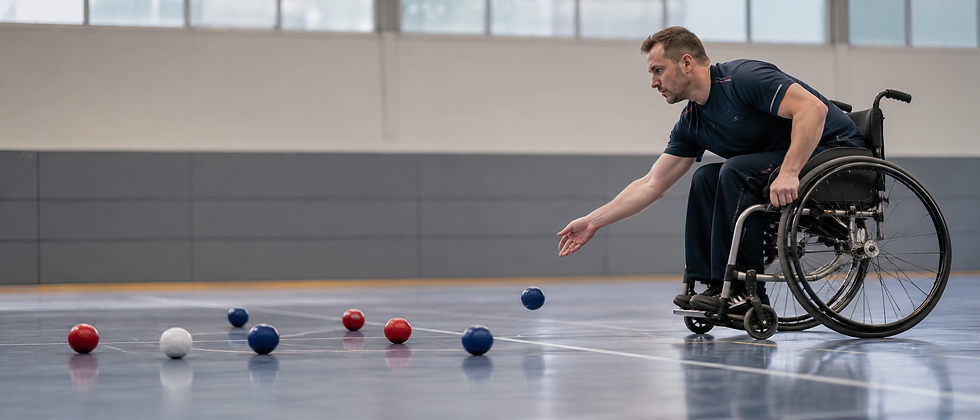
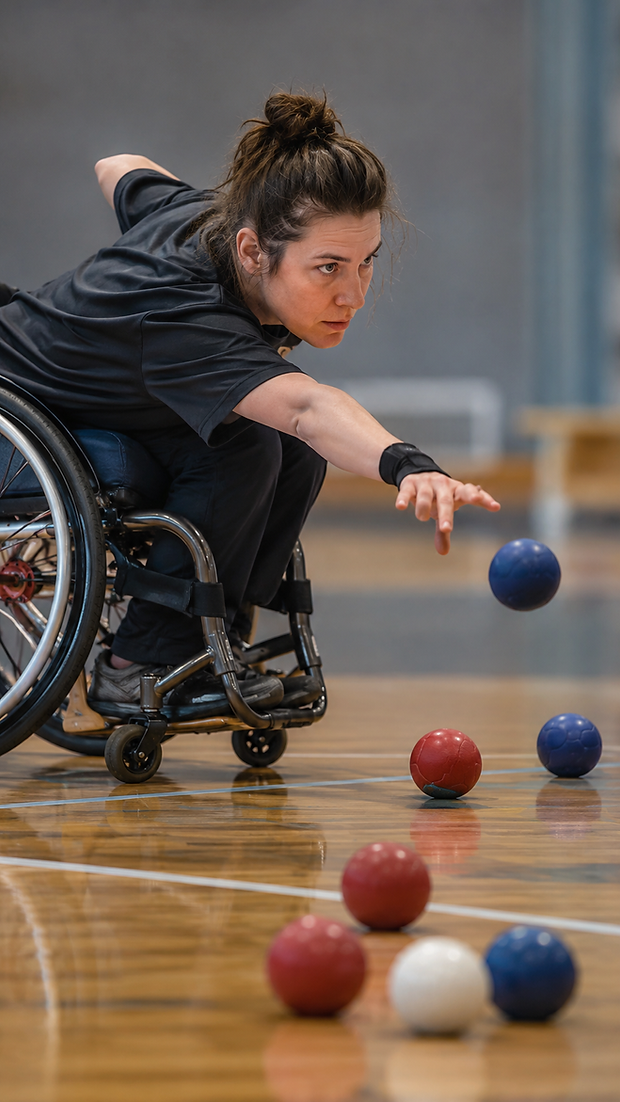

Simple Rules of Boccia
-
Boccia is played by individuals, pairs or teams.
-
One side uses red balls and the other side uses blue balls.
-
The aim is to place your coloured balls closer to the white jack ball than your opponent’s balls.
-
A full boccia set has six red balls, six blue balls and one white jack.
-
Players compete from marked throwing boxes at one end of the court.
-
The white jack is delivered first to set the target.
-
The same side that throws the jack also plays the first coloured ball.
-
After that, the side that is furthest from the jack usually plays next.
-
Players may deliver the ball by throwing, rolling, kicking or using a ramp, depending on their classification and ability.
-
In ramp play, the athlete controls the shot. The assistant helps position the ramp but must not choose the tactics.
-
Players try to score by landing close to the jack, blocking the opponent, pushing their own balls closer, knocking opposing balls away or moving the jack.
-
An end finishes when all balls have been played.
-
At the end, the referee checks which colour has the ball closest to the jack.
-
The scoring side gets one point for each ball closer to the jack than the opponent’s nearest ball.
-
The scores from each end are added together.
-
The player, pair or team with the highest total score at the end of the match wins.
-
If the score is tied after all ends, an extra end is played to decide the winner.
-
Players must wait for their turn and follow the referee’s instructions.
-
Balls that go out of bounds, are delivered incorrectly or break certain court rules may become dead balls.
-
Good boccia is not just about getting close to the jack. It is about control, patience, angles, blocking and choosing the right shot at the right time.
Career & Income Opportunities in Boccia
-
Athlete / Competitor
-
Boccia can begin through local clubs, disability sport programmes, schools, colleges, community sport sessions, rehabilitation centres or national para sport pathways.
-
Players develop accuracy, patience, shot selection, emotional control, tactical planning and match awareness.
-
Competitive routes may progress through club sessions, regional competitions, national championships, international events and Paralympic selection.
-
Income as a boccia athlete is possible, but it is usually concentrated at elite level. Money may come from athlete funding, grants, sponsorship, national team support, appearance work, scholarships, coaching, media work or wider disability sport opportunities.
-
Boccia is especially important because it offers a serious competitive route for athletes with significant physical impairments, including players who use ramps, assistants or specialist delivery methods.
-
For many athletes, the greatest value is not only income, but confidence, independence, travel, representation, competitive identity and long-term involvement in para sport.
-
-
Coaching / Instruction
-
Coaching is one of the most important long-term routes in boccia because the sport needs patient, technically aware coaches who understand accuracy, tactics and inclusive delivery.
-
Coaches may work with beginners, school groups, adult clubs, disability sport sessions, national squads, ramp players, pairs, teams or elite athletes.
-
A boccia coach needs to understand throwing technique, ramp use, ball selection, court strategy, classification, communication, match preparation and athlete confidence.
-
Coaching is not only about teaching people to roll a ball. It involves helping players read the court, manage pressure, choose shots and build a playing style that suits their body and classification.
-
Income may come from club coaching, school sessions, disability sport programmes, community projects, private coaching, holiday camps, charity work, national pathway roles or elite team appointments.
-
This route suits people who enjoy careful technical teaching, inclusive sport and long-term athlete development.
-
-
Officials / Referees
-
Boccia needs trained officials to manage matches, measure shots, apply the rules, control timing, record scores and make fair decisions.
-
Referees must understand the court, jack rules, valid and dead balls, turn order, scoring, penalties, ramp rules, assistants’ roles and match procedure.
-
Because boccia can be decided by tiny distances, measuring and calm decision-making are especially important.
-
Entry usually begins by volunteering at local events, learning the rules and completing referee training through the relevant boccia organisation.
-
Paid work is often modest at grassroots level, but experienced officials may receive expenses, event fees or appointments at larger competitions.
-
This route suits people who enjoy precision, patience, rules, fairness and being close to competition without necessarily coaching or playing.
-
-
Classification
-
Classification is central to boccia because players compete according to how their impairment affects functional movement and delivery method.
-
Classifiers assess how an athlete’s physical ability affects throwing, kicking, ramp use, trunk control, arm movement, hand control and match play.
-
Classification work is specialist and usually suits people with medical, physiotherapy, occupational therapy, sports science, coaching or high-level para sport experience.
-
Classifiers help protect fairness, making sure athletes compete in the correct class and that the sport remains balanced.
-
Income may come through national governing bodies, event work, international appointments, medical support roles or wider para sport employment.
-
This is usually not an entry-level role, but it can become a respected pathway for people with the right professional background.
-
-
Ramp Assistant / Competition Assistant
-
Some boccia athletes use ramps and require an assistant to position equipment under their instruction.
-
The assistant must not choose the shot, direct tactics or influence the athlete’s decision. Their job is to support the athlete’s choices accurately and respectfully.
-
This role requires trust, discipline, communication, patience and a strong understanding of the athlete’s preferred setup.
-
At club level, assistants may be volunteers, family members, carers, support workers or trained club helpers.
-
At higher levels, experienced assistants can become an important part of an athlete’s performance team.
-
This route may not always be a separate paid career, but it can connect to coaching, athlete support, disability sport work, care work, personal assistance, event support and performance roles.
-
-
Equipment / Ramp Design / Technical Support
-
Boccia creates opportunities around specialist equipment, including balls, ramps, pointers, ball holders, seating, trays and court setup.
-
Players may need equipment adjusted to match their strength, movement, grip, delivery angle, chair position and communication style.
-
Ramp players often rely on accurate ramp positioning, smooth ball release, stable frames and repeatable setup.
-
Technicians, designers and suppliers may work with athletes, clubs, schools, charities, equipment manufacturers, national teams or disability sport organisations.
-
Income may come from equipment sales, custom fitting, repairs, ramp design, servicing, event support or broader adaptive sports equipment work.
-
This route suits practical people with interests in engineering, product design, assistive technology, disability equipment or sports performance.
-
-
Physiotherapy / Occupational Therapy / Sports Support
-
Competitive boccia can involve physiotherapists, occupational therapists, sports therapists, psychologists, nutritionists and performance analysts.
-
Support staff may help athletes with posture, seating, fatigue management, range of movement, pain reduction, shoulder care, hand function, concentration and competition routines.
-
Occupational therapists may be especially relevant because equipment, positioning and functional movement can directly affect performance.
-
Sports psychologists may help athletes manage pressure, patience, routine, frustration and long matches.
-
Income in these roles usually comes through wider health, education, clinical or para sport work rather than boccia alone.
-
At elite level, support staff may work with national squads, Paralympic programmes, universities, rehabilitation centres or major competition teams.
-
-
Club Management / Event Organisation
-
Boccia clubs and competitions need organisers to manage venues, fixtures, entries, volunteers, safeguarding, equipment, transport, accessibility, timing and court setup.
-
Event teams may arrange court markings, match schedules, officials, scoreboards, ball checks, ramp areas, athlete support spaces and spectator areas.
-
Much grassroots work may be voluntary, but paid roles can exist in larger charities, national bodies, councils, schools, sports foundations and disability sport organisations.
-
Good organisation matters because boccia often depends on accessible venues, suitable equipment, quiet competition spaces and reliable support.
-
This route suits people who are organised, calm, practical and interested in inclusive sport delivery.
-
It can lead into wider careers in sports development, event management, disability services, leisure management or para sport administration.
-
-
Community Development / Inclusion Work
-
Boccia is one of the strongest sports for inclusive community delivery because it can be adapted for people with a wide range of physical abilities.
-
Development officers may create new clubs, run taster sessions, support schools, train volunteers, connect athletes to pathways and help families understand the sport.
-
These roles may sit within charities, councils, schools, national governing bodies, community sport trusts, disability organisations or health projects.
-
Income may come through funded programmes, session delivery, outreach work, development roles or inclusive sport projects.
-
This route suits people who care about access, confidence, participation and helping disabled athletes find genuine competitive opportunities.
-
For many communities, boccia can be the first sport where some athletes feel they are not being included as an afterthought, but placed at the centre of the game.
-
-
Media / Photography / Content Creation
-
Boccia creates opportunities in sports photography, filming, livestreaming, commentary, match reports, athlete interviews and educational content.
-
Good media coverage can help explain the sport, promote clubs, attract players, support sponsors and show the tactical depth of competition.
-
Content creators can cover rules, equipment, ramp play, classification, athlete stories, tournament reports, training routines and match strategy.
-
Income may come from freelance media work, club contracts, event coverage, YouTube channels, social media partnerships, sponsorship or wider para sport content.
-
Because boccia is precise and tactical, good storytelling is important. The drama often sits in concentration, angles, pressure and tiny margins rather than obvious speed or contact.
-
This route is strongest when boccia coverage is combined with broader disability sport, community sport, education, documentary work or para sport media.
-
BOCCIA
ORGANISATIONS
& LEAGUES
Here is a non-exhaustive set of organisations involved with Boccia worldwide.
Boccia has a clear international structure, but most players do not enter the sport through a professional league. The usual route is through local clubs, disability sport sessions, schools, community programmes, regional competitions, national championships and then international events. A beginner should search for “boccia club,” “boccia national championships,” “inclusive sport boccia,” “para sport boccia,” or their national boccia organisation, rather than only searching for professional leagues.
-
World Boccia
-
World Boccia is the international governing body for the sport and is the competition brand of the Boccia International Sports Federation, also known as BISFed.
-
It oversees the international structure of boccia, including rules, rankings, classification standards, international competitions and member nations.
-
Its current competition pathway includes major international events such as World Boccia Cups, World Boccia Challengers and World Boccia Championships. The 2026 calendar includes events in Portugal, Egypt, Poland and South Korea, including the Seoul 2026 World Boccia Championship.
-
World Boccia recognises national organisations as responsible bodies for the sport in their own countries. Full members are expected to maintain links with their National Paralympic Committee and can be eligible to host sanctioned international competitions.
-
For elite athletes, World Boccia is the highest international structure outside the Paralympic Games.
-
-
Paralympic Games
-
Boccia is a Summer Paralympic sport and has been on the Paralympic programme since 1984.
-
The Paralympic route usually runs through national classification, domestic competition, international ranking events, national squad selection and qualification for the Games.
-
Boccia is especially important because it has no direct Olympic equivalent. It is a Paralympic sport with its own identity, equipment, tactics, classifications and international pathway.
-
For many elite athletes, Paralympic selection is the highest-profile goal in the sport, but the first step is usually a local club or national development programme.
-
-
Boccia UK
-
Boccia UK is the national governing body for Paralympic boccia in the UK.
-
Its role is focused on high-performance boccia, national team activity, elite athlete development and the Paralympic pathway.
-
For athletes aiming for Great Britain selection, Boccia UK is the key performance organisation.
-
Beginners in England will often start through Boccia England or local clubs first, then progress through domestic competition before any elite pathway becomes realistic.
-
-
Boccia England
-
Boccia England runs important domestic competition and participation routes in England.
-
Its competitions include National Championships, the Heathcoat Cup, the National League and the Super League.
-
The National League is a pan-disability team competition open to clubs, groups, schools and organisations that are members of Boccia England.
-
The Super League is England’s highest domestic team boccia competition and features the top eight clubs, with teams qualifying through National League performance.
-
The National Championships provide individual competition across classifications, with qualification events leading to finals. Boccia England lists its National Championships as the highest level of domestic competition in England and open to classifications BC1 to BC8.
-
For English players, Boccia England is one of the most practical starting points for clubs, competitions, membership, volunteering and official development.
-
-
USA Boccia
-
USA Boccia is the main organisation for boccia in the United States and is connected to high-performance selection and training for American boccia athletes.
-
USA Boccia describes World Boccia/BISFed as the international governing body, while stating that USA Boccia is the national body selected by the United States Olympic and Paralympic Committee for high-performance selection and training in the USA.
-
Its domestic structure includes regional and national tournaments, with a National Championships event acting as a major competition focus.
-
The 2026 USA Boccia National Championships page lists national championship activity, domestic tournaments and tournament calendar information.
-
For American athletes, USA Boccia is the best starting point for competition calendars, national rules information, classification routes and high-performance opportunities.
-
-
Boccia Canada
-
Boccia Canada is the boccia delivery arm of the Canadian Cerebral Palsy Sports Association and supports opportunities to play the Paralympic sport across Canada.
-
Its competition structure includes the Canadian Boccia Championships, where athletes from across the country compete for national titles.
-
The Canadian Championships sit within the national competition pathway and support athlete development towards higher levels of competition.
-
For Canadian players, Boccia Canada is the key organisation for national competition, development and links into the wider Canadian para sport system.
-
-
Boccia Australia
-
Boccia Australia is the recognised National Sporting Organisation for boccia in Australia.
-
Australia also connects boccia through its Paralympic system, with Paralympics Australia describing the sport as played by athletes with significant physical impairment affecting all four limbs, in singles, pairs and teams events.
-
Australian players may progress through local programmes, state activity, national competition, international events and Paralympic selection.
-
The Australian pathway is worth watching because the country has become increasingly visible in elite boccia, especially after recent Paralympic medal success.
-
-
Boccia New Zealand
-
Boccia New Zealand supports the sport nationally and lists national championship activity, including the New Zealand National Boccia Championships.
-
Competition opportunities may include local clubs, regional events, school events, national championships and representative pathways.
-
New Zealand is a useful example of a smaller boccia nation where the national structure is still important, even if the sport does not operate like a large commercial league.
-
-
Singapore Disability Sports Council
-
In Singapore, boccia activity is connected to the Singapore Disability Sports Council.
-
SDSC describes boccia as played on a smooth hard court measuring 12.5 m by 6 m, with players aiming red or blue balls towards the jack and able to throw, roll, kick or release balls down a ramp.
-
Singapore also runs national boccia championship activity, including the Tiger Balm National Boccia Championships.
-
This shows how boccia can be organised through a national disability sport body rather than a standalone boccia federation.
-
-
Local Clubs, Schools and Community Programmes
-
Most boccia players begin locally rather than internationally.
-
A first session may be run by a boccia club, school, college, disability sport charity, leisure centre, rehabilitation centre, community sport project or local authority programme.
-
Many clubs provide shared balls, ramps, assistants, court markings and beginner support.
-
Local clubs are also where future coaches, referees, ramp assistants, classifiers, volunteers and event organisers often begin.
-
Because boccia is accessible to athletes with high support needs, good local delivery matters. Players may need suitable venues, quiet spaces, ramps, assistants, accessible transport and time to develop confidence.
-
-
Best Search Terms for Beginners
-
“boccia club near me”
-
“boccia national governing body”
-
“Boccia England club”
-
“Boccia UK Paralympic pathway”
-
“USA Boccia tournaments”
-
“Boccia Canada championships”
-
“Boccia Australia”
-
“Boccia New Zealand national championships”
-
“inclusive sport boccia”
-
“disability sport boccia sessions”
-
Boccia is not usually built around large professional leagues. It is better understood as a club, championship and international tournament sport. The route normally starts with local participation, then moves into regional or national competition, classification, national squad activity and World Boccia events for athletes with the ability and ambition to reach the highest level.

PROMOTE YOUR EVENT TO THE RIGHT SPORTS AUDIENCE
Contact us with your event details, and we can help feature suitable events on the most relevant sports page for our visitors.
SIMPLE PROCESS
Send us the event name, date and location.
RELEVANT PLACEMENT
We help match your event to the right sports audience.
EXTRA VISIBILITY
Give your event more exposure to interested visitors
(Subject to fees)