
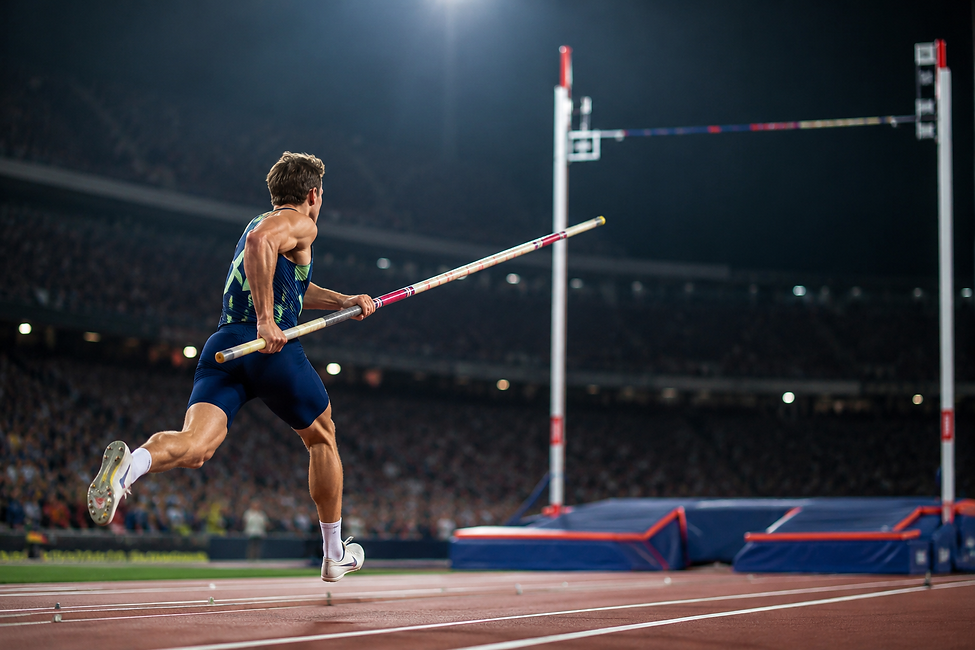
POLE VAULTER
UPCOMING EVENTS & COMPETITIONS
5–9 AUGUST 2026
World Athletics U20 Championships
Eugene, Oregon, United States
A major international pathway for leading under-20 vaulters. Athletes must achieve the required standard and be selected by their national federation. No athlete prize fund is listed.
8 AUGUST 2026
Rochester Rockback Beach Vault
Rochester, New York, United States
An open-entry competition with youth, high-school, college, open, masters and elite groups. Entry costs US$95 before 25 July, rising nearer the event. Prize money has not been published.
11–13 SEPTEMBER 2026
World Athletics Ultimate Championship
Budapest, Hungary
The highest professional level, featuring qualified Olympic, world and Diamond League champions in pole vault. Individual prize money ranges from US$150,000 for first place to US$2,000 for 16th.
Competition dates and arrangements may change. Confirm details with the event organiser before attending.
POLE VAULTER
Pole vault is one of athletics’ most dramatic events, where speed, strength, timing and courage all meet in a single jump. The athlete charges down the runway carrying a long flexible pole, plants it into the box, rises above the bar and lands safely on the mat beyond. It looks spectacular, but it is built on careful coaching, repeated practice and controlled technique.
For beginners, pole vault is not something to copy casually or attempt without proper equipment. The right route starts through an athletics club, school programme or trained coach with access to a safe runway, vault box, standards and landing bed. With the right support, the sport is open to athletes from many backgrounds, especially those with sprinting, gymnastics, jumping, climbing or general athletic ability.
POLE VAULTER AREA

The pole vault area is built around a straight runway leading into a raised jumping and landing zone. The athlete sprints down the runway carrying the pole, gradually lowering it as they approach the jump. At the end of the runway is the planting box, a recessed metal box set into the ground. This is where the vaulter drives the end of the pole before take-off, allowing the pole to bend and return energy as the athlete rises towards the bar.
The bar is held by two tall adjustable uprights, often called standards. These stand on either side of the landing area and support the crossbar at the chosen height. The crossbar itself is light and rests on small pegs, so it falls if the athlete knocks it off during the jump. The uprights can be moved and adjusted so the bar sits correctly over the landing bed and at the required competition height.
The pole is the defining piece of equipment. Modern vaulting poles are usually made from fibreglass, carbon fibre or a blend of light flexible materials. They are long, smooth and carefully selected for the athlete’s weight, speed, strength and skill level. A beginner does not simply choose the longest pole available. The correct pole must match the vaulter’s ability, because too stiff, too soft, too short or too long a pole can make the jump unsafe and technically wrong.
Behind the bar is the landing bed, sometimes called the drop pad or pit. This is a large, thick padded area designed to absorb the athlete’s fall after clearing or missing the bar. It includes the main landing mat behind the uprights and protective front sections around the box, so the vaulter has a safe area to land after the pole releases. A proper landing bed is essential. Pole vault should only be practised where the runway, box, uprights, bar and landing mats are correctly installed and supervised by a trained coach.


Simple Rules of Pole Vaulting
-
Simple Rules of Pole Vault
-
Aim of the event
The athlete tries to clear a horizontal bar set between two uprights by sprinting down a runway, planting the pole into the box, vaulting over the bar and landing safely on the padded bed. -
Starting height
The competition begins with the bar set at an agreed height. Athletes may enter the competition at that height or wait until a higher height. -
Attempts
Each athlete usually has up to three attempts to clear a height. If they clear the bar, they move on to the next height. -
Passing a height
An athlete can choose to pass a height or pass remaining attempts at a height. This can be used tactically, but any previous failures still count towards the athlete’s total consecutive failures. -
Elimination
An athlete is eliminated after three consecutive failed attempts. These failures can happen at one height or across more than one height. -
Clearing the bar
A jump is successful when the athlete clears the bar and the bar stays on its supports. The athlete may touch the bar slightly, but it must not fall. -
Failed attempts
A jump is failed if the athlete knocks the bar off with their body or pole, fails to clear the bar, does not take off correctly, or runs through without making a valid attempt after the allowed time has started. -
Planting the pole
The pole must be planted into the fixed planting box at the end of the runway. The athlete uses the pole to rise over the bar, but cannot climb up the pole by moving their hands higher during the vault. -
The pole after take-off
If the pole knocks the bar down after the athlete has released it, the jump may still be judged as a failure unless the official decides the athlete made a fair effort to push the pole away and outside conditions caused the problem. -
Broken pole
If the pole breaks during the attempt, it is normally treated as equipment failure, not as a failed jump. The athlete is given another attempt. -
Winning the competition
The winner is the athlete who clears the highest height. If two or more athletes clear the same best height, the result is decided by fewer failures at that height, then fewer failures across the whole competition. -
Jump-off
If there is still a tie for first place, a jump-off may be used. The tied athletes take extra attempts at set heights until one athlete clears and the other does not. -
Safety rule
Pole vault should only be practised with proper equipment, a correct runway, a safe planting box, suitable landing mats and trained supervision.
Career & Income Opportunities in Pole Vault
-
Athlete / Competitor
-
Pole vault begins through school athletics, local clubs, junior competitions, university athletics or open track and field meetings.
-
Most vaulters start as amateurs, training alongside other athletics events before specialising.
-
Strong competitors may progress into county, regional, national and international competition.
-
Income at lower levels is usually limited, but elite vaulters may earn through prize money, sponsorship, national funding, appearance fees, kit deals and social media.
-
In some countries, especially the United States, pole vault can also support scholarship opportunities through school and university athletics.
-
Only a small number of pole vaulters earn a full-time living from competing alone, so many combine competition with coaching, education, work or media activity.
-
-
Coaching / Instruction
-
Coaching is one of the most realistic long-term income routes in pole vault because the event is highly technical and cannot be learned safely without proper guidance.
-
Coaches may work with beginners, junior athletes, school teams, university squads, athletics clubs, private training groups or elite vaulters.
-
A pole vault coach needs strong knowledge of sprinting, take-off technique, pole carry, plant mechanics, gymnastics-style movement, safe landing and equipment choice.
-
Income may come from club coaching fees, private sessions, school programmes, training camps, academy work or national federation roles.
-
Former athletes often move into coaching because practical vaulting experience is valuable, especially when combined with formal coaching qualifications.
-
-
Officials / Referees
-
Pole vault competitions need trained officials to manage attempts, measure heights, check the bar, record results, judge failures and keep the event moving safely.
-
Officials are important because pole vault involves changing heights, athlete passes, time limits, equipment issues and safety decisions.
-
Entry usually begins by volunteering at local athletics meetings, then taking official training through the relevant athletics body.
-
Paid work is usually modest at grassroots level, but experienced officials may receive expenses, fees or appointments at larger competitions.
-
This route suits people who enjoy athletics but do not necessarily want to coach or compete.
-
-
Facilities / Grounds / Equipment Staff
-
Pole vault requires a properly maintained runway, planting box, uprights, crossbar and landing bed, so facility work is more important here than in many simple running events.
-
Staff may help set up the vault area, inspect mats, adjust standards, maintain the runway surface, store poles safely and ensure the landing area is fit for use.
-
Athletics clubs, schools, universities, stadiums and training centres all need people who understand safe event preparation.
-
Income may come through sports ground maintenance, athletics facility management, event setup, equipment supply, equipment inspection or stadium operations.
-
This is a practical route for people interested in sport infrastructure rather than direct competition.
-
-
Media, Support & Other Opportunities
-
Pole vault creates opportunities around sports photography, video analysis, event media, athlete content, commentary, strength and conditioning, physiotherapy, sports science and equipment advice.
-
Video analysis is especially useful because small changes in the approach, plant and take-off can dramatically affect the jump.
-
Support specialists may work with athletes on sprint speed, strength, mobility, confidence, nutrition, injury prevention and competition preparation.
-
Content creators can build useful material around technique explanation, training progress, equipment education and competition coverage.
-
Businesses may also exist around pole supply, track equipment, landing mats, private camps, athlete clinics and specialist vault training centres.
-
For most people, these opportunities are more realistic when combined with athletics experience, coaching knowledge or a wider sports career.
-
POLE VAULTING
ORGANISATIONS
& LEAGUES
Here is a non-exhaustive set of organisations involved with Pole Vaulting worldwide.
Pole vault does not usually have its own league system. In most countries it sits inside athletics, track and field, or field-event programmes. A beginner should not search only for “pole vault leagues,” because that may miss the real route into the sport. The better search is for athletics clubs, jumps coaches, field-event training groups, open track and field meetings, school athletics, university athletics, national championships and competitions that include pole vault.
Because pole vault needs specialist equipment, the most important first step is finding a club or training centre that actually has a runway, planting box, uprights, landing bed and qualified supervision. A normal running club may not be enough. Look for clubs that advertise field events, jumps squads, combined events, decathlon, heptathlon or pole vault coaching.
-
World Athletics
-
The international governing body for athletics.
-
Useful for global rules, rankings, records, major championships and finding each country’s national athletics federation.
-
Contact route: use the official World Athletics contact form.
-
Best for: international standards, rules, records, rankings and national federation lookup.
-
-
UK Athletics / England Athletics
-
UK Athletics is linked to elite British athletics and international performance pathways, while England Athletics is more useful for most English club-level routes.
-
For beginners in England, England Athletics is usually the more practical starting point because it connects to clubs, coaching, competitions and grassroots development.
-
Contact route: UK Athletics has an official contact form. England Athletics can be contacted through its contact form or by phone on 0121 347 6543.
-
Best for: UK performance pathways, English clubs, coaching, competition entry and local athletics guidance.
-
-
USA Track & Field
-
USA Track & Field is the main national governing body for athletics in the United States.
-
Pole vault appears through youth athletics, high school competition, college athletics, clubs, open meets, national championships and elite selection.
-
Contact route: USATF National Office, 342 Massachusetts Avenue, Indianapolis, IN 46204. Phone: 317-261-0500. General enquiries are handled through the official USATF contact form.
-
Best for: American clubs, youth competition, national championships, athlete membership and elite progression.
-
-
Athletics Canada
-
Athletics Canada is the national body for track and field in Canada.
-
Pole vault progression normally runs through local clubs, provincial branches, university athletics and national competitions.
-
Contact route: use the official Athletics Canada contact form or staff directory. The organisation directs enquiries through its website rather than relying on one public general email.
-
Best for: Canadian clubs, provincial bodies, coach lookup, safe sport standards and national competition.
-
-
Australian Athletics
-
Australian Athletics oversees track and field in Australia, with state and territory bodies feeding into the national structure.
-
Pole vault is not available at every track, so readers should look for state athletics bodies, field-event clubs and venues with proper vault facilities.
-
Contact route: Athletics House, Level 2, 31 Aughtie Drive, Albert Park VIC 3206. Email: hello@athletics.org.au. Phone: +61 3 8646 4550.
-
Best for: Australian clubs, state competition, national championships, youth development and coach-led progression.
-
-
Fédération Française d’Athlétisme
-
The French Athletics Federation governs athletics in France, including pole vault, known as saut à la perche.
-
France has a strong pole vault culture, with serious indoor athletics, club structures and a history of elite vaulters.
-
Contact route: 33 Avenue Pierre de Coubertin, 75640 Paris Cedex 13. Phone: 01 53 80 70 00. Email: ffa@athle.fr. The federation also provides an online contact form.
-
Best for: French clubs, indoor athletics, competition pathways and elite European pole vault examples.
-
-
Deutscher Leichtathletik-Verband
-
The German Athletics Federation governs track and field in Germany.
-
Readers in Germany should search for Stabhochsprung, the German term for pole vault.
-
Contact route: Alsfelder Straße 27, 64289 Darmstadt. Phone: +49 6151 7708-0. Email: zentrale@leichtathletik.de.
-
Best for: German clubs, structured competition, specialist field-event meetings and national athletics development.
-
-
Svensk Friidrott
-
Svensk Friidrott is the Swedish athletics federation.
-
Readers in Sweden should search for stavhopp, the Swedish term for pole vault.
-
Contact route: c/o Bauhaus Sickla, Sickla Allé 2-4, 131 65 Nacka. General email: info@friidrott.se.
-
Best for: Swedish clubs, national competition, elite inspiration and understanding how a smaller country can still produce world-class vaulters.
-
-
Athletics South Africa
-
Athletics South Africa is the national athletics body for South Africa.
-
Pole vault sits within track and field competition, although access depends heavily on available facilities and coaching.
-
Contact route: No. 3, 11th Avenue, Houghton Estate, Johannesburg 2198, Gauteng. For track and field enquiries, the official contact page lists the Track & Field Chairperson, Jean Verster, with phone 082 923 6399 and email jean.verster@nwu.ac.za. The ASA office contact page also lists staff contacts for administration and reception.
-
Best for: South African competition, African pathway examples, youth athletics and regional development.
-
For a beginner, the practical route is simple: find the national athletics federation, then the regional or state body, then a club with pole vault equipment and a qualified coach. This matters more in pole vault than in many running events because safe facilities and specialist coaching are not optional.

PROMOTE YOUR EVENT TO THE RIGHT SPORTS AUDIENCE
Contact us with your event details, and we can help feature suitable events on the most relevant sports page for our visitors.
SIMPLE PROCESS
Send us the event name, date and location.
RELEVANT PLACEMENT
We help match your event to the right sports audience.
EXTRA VISIBILITY
Give your event more exposure to interested visitors
(Subject to fees)