

GOLF
UPCOMING EVENTS & COMPETITIONS
11–16 OCTOBER 2026
Rabat International Golf Festival
Rabat, Morocco
Open to amateur golfers of different levels, with four Stableford rounds across three courses. One course has a maximum handicap of 18.
1–6 NOVEMBER 2026
Dubai Open
Dubai, United Arab Emirates
Open to male and female amateur club golfers. Five individual Stableford rounds are played, with entry currently available and an official handicap required.
22–28 NOVEMBER 2026
Malaysia World Masters
Kuala Lumpur, Malaysia
An open international event for club golfers, using Stableford scoring and handicap-based divisions across four leading Malaysian courses. Registration is currently open.
Competition dates and arrangements may change. Confirm details with the event organiser before attending.
GOLF
Golf is a precision sport built around distance control, decision-making, touch and patience. Players move across a course hole by hole, striking a small ball from the teeing area towards a distant hole on the putting green. The challenge is not just hitting the ball far, but choosing the right club, judging wind, avoiding hazards, reading slopes and recovering from mistakes.
Golf can be played casually, socially, competitively or professionally. It suits many ages and body types because power helps, but skill, rhythm, strategy and consistency matter just as much. At the highest level it is a global professional sport with tours, major championships, sponsorships and international events, while at local level it supports a large working world of coaching, club management, greenkeeping, equipment fitting, retail, events, hospitality and media.
THE GOLF COURSE

A golf course is not a fixed rectangle or arena. It is usually a landscaped outdoor course made up of separate holes, most commonly 18 holes, although 9-hole courses, short courses, par-3 courses, driving ranges and indoor golf centres are also common. Each hole starts from a teeing area and ends at a putting green, where the hole and flagstick are located. Between them are fairways, rough, bunkers, trees, slopes, water, penalty areas and other course features designed to test accuracy and judgement. The official rules divide the course into five defined areas: the general area, the teeing area, penalty areas, bunkers and the putting green of the hole being played.
Each hole has a par, which is the expected number of strokes a skilled player should take to complete it. A short hole is usually a par 3, a medium hole is usually a par 4, and a long hole is usually a par 5. The scorecard shows the par, distance, stroke index and tee options for each hole. Modern courses usually offer different tee positions so beginners, juniors, women, seniors, club players and elite players can all play the same course at a suitable distance.
Main Course Features
Teeing Area
The starting point for each hole. The player places the ball between the tee markers and may use a small tee peg to lift the ball off the ground.
Fairway
The shorter grass route towards the green. This is the preferred landing area because it gives the cleanest next shot.
Rough
Longer grass beside the fairway. Shots from rough are harder to control because the grass can slow the club and affect spin.
Bunker
A sand hazard usually placed near fairways or greens. Bunkers punish poor direction or distance control and require specialist technique.
Penalty Area
Usually water, ditches, marked rough or protected areas where special relief rules apply. A player may sometimes play from a penalty area, but often takes relief with a penalty stroke.
Putting Green
The closely cut area around the hole. Players use a putter here and must read slope, speed and break carefully.
GOLF CLUB TYPES
Driver
The driver has the largest head in the bag and is used mainly from the tee on long holes. Its broad, hollow head is designed to hit the ball the greatest distance, with a large face that gives more forgiveness on slightly off-centre strikes. It is powerful but less precise than shorter clubs.
Fairway Wood
A fairway wood has a smaller head than a driver but is still rounded and hollow. It is used for long shots from the fairway, from a tee on tighter holes, or when the player wants distance with more control than a driver. The curved sole helps it sweep the ball from grass.
Hybrid / Rescue Club
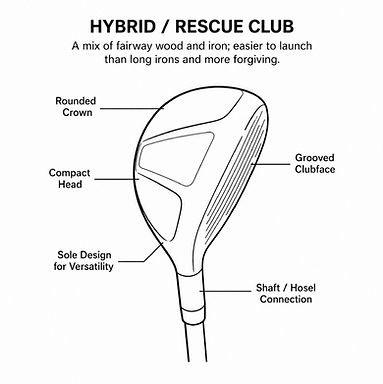
A hybrid blends features of a fairway wood and an iron. The head is usually compact, rounded and easier to launch than a long iron. It is often used from rough, fairway or awkward lies where a traditional long iron would be difficult. It is popular because it gives ordinary players a more forgiving long-distance option.
Long Iron
Long irons, such as a 3-iron or 4-iron, have thinner heads and less loft. They are designed for long, lower, more controlled shots, but they are harder to hit well. Many amateur players now replace them with hybrids because long irons demand cleaner contact.
Mid Iron
Mid irons, such as 5-, 6- and 7-irons, are used for controlled approach shots from medium distance. The heads are flatter than woods, with angled faces that lift the ball into the air. They balance distance and accuracy.
Short Iron
Short irons, such as 8- and 9-irons, have more loft and are used for shorter approach shots into the green. The higher loft gives the ball more height, more stopping power and better control.
Wedge
A wedge is a highly lofted club used for short shots, chips, pitches, bunker shots and recovery play around the green. The head often looks heavier and more angled than a normal iron. Different wedges have different lofts and soles, such as pitching wedge, gap wedge, sand wedge and lob wedge. Their purpose is control, height, spin and stopping the ball quickly.
Sand Wedge
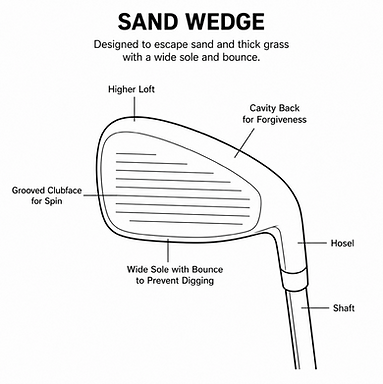
A sand wedge is specially shaped to help the club move through sand or thick grass. It usually has a wide sole and bounce angle, which helps stop the club digging too deeply. It is mainly used from bunkers, but also for short soft shots around the green.
Lob Wedge
A lob wedge has very high loft and is used when the player needs the ball to rise steeply and land softly. It is useful when hitting over a bunker, slope or obstacle near the green, but it requires skill because the margin for error is small.
Putter
The putter has the flattest face and is used on the putting green to roll the ball rather than lift it. Putter heads vary widely: some are simple blade shapes, while others are large mallet shapes designed for stability and alignment. The aim is accuracy, feel and distance control, not power.






Simple Rules of Golf
Golf is played by hitting a ball from the teeing area into a hole on the putting green in as few strokes as possible. Each hole is played separately, and the player’s score is based on the number of strokes taken, plus any penalty strokes.
Basic Aim
-
The aim is to complete each hole in the fewest strokes possible.
-
A full round is usually played over 18 holes, although 9-hole rounds are also common.
-
Each hole has a par, which is the expected number of strokes a skilled player should take.
-
A score lower than par is good; a score higher than par means the player took extra strokes.
Starting a Hole
-
Each hole begins from the teeing area.
-
The ball must be played from between the tee markers.
-
A player may use a small tee peg for the first shot of the hole.
-
Different tee positions are used for different abilities, ages, competitions and course lengths.
Playing the Ball
-
The basic rule is to play the ball as it lies.
-
Players should not move the ball, improve the ground around it, press down grass, or change the conditions to make the next shot easier unless the rules allow it.
-
After each stroke, the player continues from where the ball comes to rest.
-
The hole is completed when the ball is holed in the cup.
Scoring
-
Every attempted stroke counts.
-
Penalty strokes are added when a rule is broken or when a player takes relief from certain situations.
-
In stroke play, all strokes are added together and the lowest total score wins.
-
In match play, players compete hole by hole. The player who wins the most holes wins the match.
Clubs and Equipment
-
A player may carry no more than 14 clubs during a round.
-
A player can carry fewer than 14 clubs if they choose.
-
The player chooses which club to use depending on distance, lie, wind, hazards and the type of shot needed.
-
Drivers and woods are used for long shots, irons for controlled approach shots, wedges for short shots, and putters for rolling the ball on the green.
Fairway, Rough and Hazards
-
The fairway is the shorter grass and usually gives the best position for the next shot.
-
The rough is longer grass and makes the shot harder.
-
Bunkers are sand areas that require a different technique.
-
Penalty areas are usually water, ditches or marked difficult areas where special relief rules apply.
Penalty Areas
-
A ball in a penalty area can be played as it lies if the player can safely and practically hit it.
-
If the player does not want to play it from the penalty area, they may take relief.
-
Taking relief from a penalty area usually adds one penalty stroke.
-
Red and yellow penalty areas have slightly different relief options, so players should check how the area is marked.
Lost Ball and Out of Bounds
-
If a ball is lost or out of bounds, the player usually takes stroke-and-distance relief.
-
This means adding one penalty stroke and playing again from where the previous shot was made.
-
A ball is usually considered lost if it is not found within three minutes of searching.
-
If a player thinks the ball may be lost or out of bounds, they may play a provisional ball to save time.
-
The player must clearly say they are playing a provisional ball before hitting it.
Bunkers
-
A bunker is a sand hazard.
-
The player may play the ball from the bunker if possible.
-
The player must not deliberately improve the sand around the ball before the shot.
-
Bunker shots usually need a higher-lofted club, often a sand wedge.
The Putting Green
-
On the putting green, the player uses a putter to roll the ball towards the hole.
-
The ball may be marked, lifted and cleaned on the green.
-
Players may repair pitch marks and some damage on the green.
-
The aim is to judge the slope, speed and direction of the putt.
Unplayable Ball
-
A player may decide their ball is unplayable if it is in a position where they cannot reasonably hit it.
-
The player normally adds one penalty stroke and takes relief.
-
Relief options usually include replaying from the previous spot, dropping back on a line from the hole, or dropping within a set distance no nearer the hole.
-
A ball cannot be declared unplayable in a penalty area; penalty area rules apply instead.
Order of Play and Safety
-
Players must make sure the area ahead is clear before hitting.
-
No one should stand too close to the player, behind the ball, or in a dangerous position.
-
In casual golf, players often use “ready golf,” where the safe and prepared player hits first to keep play moving.
-
In match play, order of play can matter more because playing out of turn may have consequences.
Etiquette and Pace
-
Golf relies heavily on honesty and respect.
-
Players are expected to count their own strokes accurately.
-
Players should repair pitch marks, replace divots and rake bunkers after use.
-
Players should avoid slow play and allow faster groups through where appropriate.
-
Noise and movement should be kept low while another player is preparing to hit.
Handicaps
-
Golf uses handicaps so players of different abilities can compete more fairly.
-
A handicap adjusts a player’s score based on ability and course difficulty.
-
This allows beginners, casual players and experienced golfers to take part in the same competitions.
Income & Career Possibilities
Career & Income Opportunities in Golf
Golf can create income through playing, coaching, officiating, course care and the wider business built around clubs, ranges, events, retail and media. The professional playing route is the most visible, but it is also the hardest. For many people, golf becomes a career through coaching, club work, greenkeeping, rules administration, equipment, events or services linked to the sport.
Players
-
The playing pathway usually starts with casual rounds, lessons, school golf, junior golf, beginner sessions or local club membership.
-
Players then progress through handicap competitions, club events, county or regional events, national amateur competitions and elite amateur pathways.
-
The strongest players may attempt qualifying schools, development tours, mini-tours or national professional circuits.
-
The route can be understood as:
-
Beginner player
-
Club golfer
-
Serious amateur
-
Elite amateur
-
Trainee professional or tour hopeful
-
Development tour player
-
Full professional tour player
-
-
Income at beginner and amateur level is usually limited or non-existent.
-
Amateur players may gain value through coaching access, scholarships, equipment support, travel support or elite development programmes.
-
Professional players can earn through:
-
Prize money
-
Sponsorship
-
Endorsements
-
Appearance fees
-
Team events
-
Exhibition matches
-
Coaching or clinics
-
Media work
-
Social media and content
-
-
Reaching tour level is difficult and expensive because players often pay for travel, accommodation, entry fees, coaching, equipment, fitness support and caddie costs before earning reliable money.
-
A realistic approach is to build playing ability while also developing another golf income route, such as coaching, club work, caddying, fitting, events or media.
-
Golf is unusual because a strong player can still earn from the sport without becoming a famous tournament professional.
Coaches
-
Coaching is one of the strongest and most realistic golf career routes.
-
Coaches help beginners, juniors, club players, improvers, elite amateurs, professionals, senior players and disabled golfers.
-
A coaching route may begin through:
-
Becoming a trainee professional
-
Working at a golf club
-
Assisting with junior sessions
-
Learning from an established coach
-
Completing recognised coaching qualifications
-
Building a client base at a club, academy or driving range
-
-
Coaching income can come from:
-
One-to-one lessons
-
Group lessons
-
Junior programmes
-
Beginner courses
-
Short game clinics
-
Putting lessons
-
Swing analysis
-
Video coaching
-
Online coaching
-
Corporate golf days
-
Golf schools and holiday camps
-
-
A coach may specialise in:
-
Beginners
-
Juniors
-
Women’s golf
-
Senior players
-
Disabled golfers
-
Elite performance
-
Driving distance
-
Short game
-
Putting
-
Course management
-
Mental performance
-
-
Good coaches need more than playing skill. They need communication, patience, observation, planning, people skills and the ability to explain technical ideas simply.
-
A coach can remain self-employed, work for a club, work for an academy, travel with players or build an online teaching business.
-
Coaching is often a better long-term income route than chasing tournament prize money alone.
Referees, Rules Officials and Competition Staff
-
Golf does not use referees in the same way as football or boxing, but tournaments need rules officials, referees, starters, scorers, marshals and competition organisers.
-
At club level, many of these roles begin through volunteering, helping with competitions or joining a club committee.
-
A rules official helps players apply the rules correctly during competition.
-
A referee may be assigned to a match, group or specific part of a tournament.
-
Competition staff help organise:
-
Tee times
-
Scorecards
-
Handicaps
-
Draws
-
Starting groups
-
Pace of play
-
Course markings
-
Local rules
-
Results
-
Prize tables
-
-
Income can come from:
-
Paid tournament roles
-
Event administration
-
Golf union work
-
Club competition management
-
Championship support
-
Consultancy for events
-
Rules education
-
-
This route is often part-time at first.
-
It suits people who are organised, calm, fair, detail-focused and interested in the structure of the sport.
-
Officiating and rules work can also lead towards wider jobs in golf administration, national governing bodies, tournament operations and event management.
-
It is a good route for someone who loves golf but does not want their income to depend on playing or coaching.
Grounds Staff and Greenkeepers
-
Grounds staff are essential because the golf course itself is the playing surface.
-
Greenkeepers maintain the greens, tees, fairways, bunkers, rough, drainage, irrigation, trees, paths and practice areas.
-
A typical route may begin as:
-
Grounds assistant
-
Apprentice greenkeeper
-
Assistant greenkeeper
-
Deputy head greenkeeper
-
Head greenkeeper
-
Course manager
-
-
Greenkeeping work can include:
-
Mowing greens and fairways
-
Preparing holes and tee markers
-
Raking and repairing bunkers
-
Managing irrigation
-
Treating turf disease
-
Improving drainage
-
Maintaining machinery
-
Managing soil and grass health
-
Preparing the course for competitions
-
Repairing wear and weather damage
-
-
Good greenkeepers understand grass, soil, water, machinery, weather, ecology and how golfers experience a course.
-
The work is practical, outdoor and physically active.
-
Income is usually from employment by golf clubs, resorts, councils, private estates, contractors or sports turf companies.
-
Senior greenkeeping roles can become serious management jobs, especially at large clubs, championship courses and golf resorts.
-
This route suits people who like land management, sport, machinery, practical work and visible daily results.
Miscellaneous Golf Careers and Side Income
-
Golf has a large supporting economy beyond the course and the player.
-
These roles can be full-time jobs, part-time work, freelance services or side hustles.
-
Common golf-related income routes include:
-
Club management
-
Pro shop work
-
Golf retail
-
Club fitting
-
Club repair
-
Equipment sales
-
Caddying
-
Golf events
-
Corporate golf days
-
Golf travel planning
-
Golf photography
-
Golf videography
-
YouTube and social media content
-
Blogging and newsletters
-
Podcasting
-
Golf fitness
-
Sports therapy
-
Physiotherapy
-
Nutrition
-
Mental performance support
-
Hospitality and clubhouse work
-
Membership sales
-
Sponsorship sales
-
Golf marketing
-
-
Caddies can earn by carrying bags, reading greens, advising on club choice and helping players manage the course.
-
Club fitters earn by matching players with suitable clubs, shafts, grips and specifications.
-
Golf retailers earn through equipment, clothing, balls, shoes, gloves, bags and accessories.
-
Event organisers can run society days, charity events, junior events, amateur competitions and corporate golf days.
-
Content creators can earn through adverts, sponsorship, affiliate links, coaching products, course reviews and equipment reviews.
-
Golf resorts and large clubs also need staff in hospitality, food and drink, reception, maintenance, finance, administration and sales.
-
The miscellaneous route is important because it allows people to earn from golf even if they are not elite players.
-
For many beginners, the most realistic first step is not tournament golf, but local club work, coaching assistance, retail, events, greenkeeping, caddying or content creation.
GOLF
ORGANISATIONS
& LEAGUES
Here is a non-exhaustive set of organisations involved with Golf worldwide.

PGA Tour / Korn Ferry Tour
-
Region: North America
-
Main focus: Elite men’s professional golf and development pathway
-
The PGA Tour is one of the strongest professional golf circuits in the world.
-
The Korn Ferry Tour is the main development route into the PGA Tour system.
-
Useful for players aiming at elite tournament golf.
-
Also useful for people interested in tournament operations, media, sponsorship, statistics, event management, caddying and sports business.
-
This is not a beginner route, but it shows where the top end of professional golf income can lead.
-
Best for: elite male players, development tour players, caddies, golf media, event staff and sports business careers.

The PGA: Great Britain and Ireland
-
Region: Europe / British Isles
-
Main focus: Coaching, club professionals and golf industry training
-
The PGA in Great Britain and Ireland is one of the most important routes for people who want to work in golf in the UK and Ireland.
-
It is especially relevant for coaching, club professional roles, pro shop work, golf operations, junior development and golf business careers.
-
This route is more realistic for many people than chasing tournament prize money.
-
It can lead to work at golf clubs, academies, driving ranges, resorts and private coaching businesses.
-
Best for: UK and Ireland coaching routes, club professional careers, golf jobs and trainee professional pathways.

Sunshine Tour
-
Region: Africa
-
Main focus: Professional golf in Southern Africa
-
The Sunshine Tour is the key professional golf circuit in Southern Africa.
-
It is especially important for South African players and for golfers looking for a serious African tournament pathway.
-
It can lead to playing opportunities, caddying, event work, sponsorship, media, course hosting and tournament operations.
-
It also matters because South Africa has a strong golf culture and has produced major championship players.
-
Best for: African professional players, Southern African golf careers, caddies, tournament work and regional golf development.
PGA of America
-
Region: North America
-
Main focus: Coaching, club professionals and golf industry careers
-
The PGA of America is more useful for many ordinary golf careers than the tournament tour itself.
-
It supports the working golf professional route, including coaching, club operations, golf management, teaching and player development.
-
This is a strong route for people who want to earn from golf without needing to become a tour star.
-
Career links can include teaching professional, head professional, director of golf, club manager, junior development coach and golf operations roles.
-
Best for: coaching, club careers, golf operations and professional qualification routes in the United States.
.png)
DP World Tour / HotelPlanner Tour
LPGA / Epson Tour
-
Region: North America
-
Main focus: Women’s professional golf and development pathway
-
The LPGA is the leading women’s professional golf tour.
-
The Epson Tour is the development route often described as the road to the LPGA.
-
This pathway matters because women’s golf has its own professional structure, sponsors, events and player development routes.
-
There are also wider opportunities around coaching, media, junior girls’ golf, event work and brand partnerships.
-
This is one of the clearest places to direct ambitious female players.
-
Best for: female players, women’s golf careers, development tour progression, sponsorship and female golf media.

Asian Tour
-
Region: Europe
-
Main focus: European men’s professional golf and development pathway
-
The DP World Tour is the main European men’s professional circuit.
-
The HotelPlanner Tour is the second-tier route beneath it and is important for players trying to climb into higher-level professional golf.
-
This pathway is useful for players, caddies, tournament staff, media workers, event organisers and sponsorship teams.
-
It is also relevant for golfers outside Europe because the tour structure has links to many countries and events.
-
Best for: European professional players, development tour players, caddies, tournament staff and golf media.
-
Region: Asia
-
Main focus: Professional men’s golf across Asia
-
The Asian Tour is the main professional men’s golf tour across much of Asia.
-
It gives players in the region a route into professional tournament golf without needing to start in Europe or the United States.
-
It is useful for players, caddies, tournament staff, sponsors, media workers and golf event businesses.
-
Asia is also an important region for golf growth, golf tourism, equipment sales and resort development.
-
Best for: Asian professional players, regional tournament careers, caddies, golf events and sponsorship opportunities.

PGA Tour Americas
-
Region: South America / Latin America / North America
-
Main focus: Development tour pathway towards the Korn Ferry Tour
-
PGA Tour Americas is important because it gives players in Latin America and North America a clearer route towards higher professional golf.
-
It replaced older separate regional structures and now acts as a development bridge.
-
Strong performance can lead towards Korn Ferry Tour opportunities.
-
It is especially useful for ambitious players from Latin America who need a route into the wider professional system.
-
It also creates opportunities for event staff, host clubs, local sponsors, media, volunteers and caddies.
-
Best for: Latin American players, South American player pathways, development tour golf and tournament experience.

PGA of Australia / Challenger PGA Tour of Australasia

EDGA / G4D Tour
-
Region: Diversity and disability golf pathway
-
Main focus: Golfers with disabilities and adaptive golf opportunities
-
EDGA and the G4D pathway are important because they support competitive and inclusive golf for players with disabilities.
-
This route can involve adaptive coaching, disability golf events, classification, player development, inclusion training and tournament pathways.
-
It is useful for disabled golfers, coaches, clubs, event organisers and anyone building a more inclusive golf environment.
-
Golf is one of the sports where adaptive participation can be developed strongly because different abilities can often be accommodated through equipment, rules support, course setup and coaching.
-
Best for: disabled golfers, adaptive golf coaches, inclusive clubs, disability sport pathways and accessible golf development.

PROMOTE YOUR EVENT TO THE RIGHT SPORTS AUDIENCE
Contact us with your event details, and we can help feature suitable events on the most relevant sports page for our visitors.
SIMPLE PROCESS
Send us the event name, date and location.
RELEVANT PLACEMENT
We help match your event to the right sports audience.
EXTRA VISIBILITY
Give your event more exposure to interested visitors
(Subject to fees)