

PARA SWIMMING
UPCOMING EVENTS & COMPETITIONS
27 JULY–1 AUGUST 2026
Swim England National Summer Meet
Sheffield, England
A national long-course meet with a dedicated entry route for qualifying Para swimmers. Late entries remain available until 26 July, making this the clearest immediate progression opportunity. No prize money is listed.
13–16 AUGUST 2026
Para Swimming World Series Mexico
Guadalajara, Mexico
Elite swimmers, emerging athletes and newcomers compete for World Series ranking points. International classification is offered from 10–12 August, although competition entries have now closed. No prize fund is listed.
28–30 AUGUST 2026
Para Pan Pacific Swimming Championships
Walnut, California, United States
A major development championship providing international exposure for selected Para swimmers from Pacific nations. Athletes must meet qualification standards and enter through their national programme. No prize money is listed.
Competition dates and arrangements may change. Confirm details with the event organiser before attending.
PARA SWIMMING
Para swimming is a fast, technical and highly competitive form of pool swimming for athletes with physical, visual or intellectual impairments. Swimmers compete across different strokes, distances and classifications, using skill, strength, endurance and precise race technique.
From local clubs and development programmes to national championships and the Paralympic Games, para swimming offers clear routes into competition, coaching, officiating, sports science and event support. Explore how the sport works, how classification affects racing, what training involves and where a career in para swimming can lead.
PARA SIMMERS POOL AND CONDITIONS

The Para Swimming Pool
Para swimming takes place in a standard competitive swimming pool. The water, lanes, starting blocks, timing equipment and race distances are the same as those used in other forms of competitive swimming. The pool is not shortened or made easier because the athletes have impairments.
Competitions may be held in a 25-metre short-course pool or a 50-metre long-course pool. Major international events normally use a 50-metre Paralympic-standard pool. The lanes are separated by wave-reducing ropes and are usually 2.5 metres wide, giving each swimmer a clear racing space. Dark lines along the pool floor help swimmers remain centred, while markings and coloured lane-rope sections indicate the approach to the walls. Backstroke flags are suspended five metres from each end.
At the highest level, the pool contains starting platforms, backstroke grips, electronic
touchpads and automatic timing equipment.
The water is maintained between 25°C and 28°C, with as little current or turbulence as possible. World Para Swimming also requires competition pools and their surrounding facilities to be accessible. Protective mats are positioned near the outside lanes at major events to provide a safer surface where swimmers or support staff may need them.
Accessing the Water
The route from the changing area to the pool is an important part of the swimmer’s experience. Some athletes can walk independently to the starting area, while others may use a wheelchair, walking aid or assistance from support staff. The poolside is wet, noisy and busy, so swimmers should become familiar with the access route, starting end and method of entering and leaving the water before training or competition begins.
A local training facility may provide steps, a ramp, a pool hoist or another assisted entry method. The swimmer, coach and facility staff should agree in advance how assistance will be given, particularly where balance, grip, mobility or vision is limited. At recognised competitions, support staff may only provide assistance that has been authorised for that swimmer.
Starting the Race
Not every para swimmer begins from a standing dive. Depending on the swimmer’s impairment and authorised exception codes, the start may be made:
-
Standing on the starting block
-
Sitting on the starting block
-
From beside the block
-
From within the water
-
With support to maintain balance or a starting position
-
With an approved starting device
Support staff may hold or steady an athlete where this has been authorised, but they cannot push the swimmer or provide forward momentum. Swimmers who start in the water must remain in contact with the wall or starting position until the signal is given. Athletes with hearing impairments may receive a starting light, strobe or another approved visual signal.
Swimming Without a Prosthesis
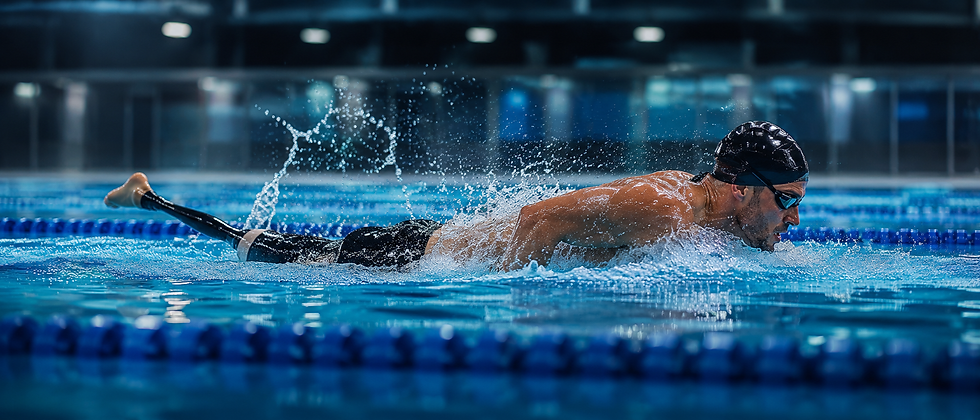
Swimmers compete using their own bodies rather than racing prostheses. Prosthetic limbs and orthoses are not permitted during a race, apart from ocular prostheses. Cochlear implants and insulin pumps are permitted under World Para Swimming rules.
Removing a prosthetic limb can change the swimmer’s balance, buoyancy and body position. A limb difference, restricted movement or reduced muscle power may cause the body to rotate, drift towards a lane rope or sit differently in the water. Training therefore concentrates on finding the most efficient stroke for that individual swimmer rather than forcing every athlete into an identical technique.
Turns, Touches and Finishes
The walls are solid and fitted with touchpads at competition level. Swimmers use them to turn, push off and complete the race. Athletes are still expected to follow the rules of the stroke, but some receive approved technical exceptions where their impairment makes a standard movement impossible.
An athlete may, for example, be allowed to make a one-handed touch in breaststroke or butterfly, demonstrate an intention to perform a simultaneous movement, or use an adapted starting grip. These permissions are recorded through exception codes and communicated to officials before the race. They are specific to the athlete and do not provide a general relaxation of the rules.
Swimmers with Visual Impairments
Swimmers with visual impairments may have difficulty judging lane position, the distance to the wall or the exact point at which to begin a turn. Some use a tapper, a trained assistant standing at the end of the pool with an approved soft-ended tapping device. The swimmer is lightly touched on the head, shoulder or upper body to warn that the wall is approaching.
Tapping must be practised carefully. The timing needs to remain consistent so that the swimmer knows how many strokes remain before the turn or finish. S11 swimmers also compete in blackened goggles to create comparable racing conditions within the class.
What the Swimmer Should Expect
Para swimming uses a familiar competitive pool, but each athlete experiences it differently. The swimmer must learn how their body floats, how strongly they can push from the wall, whether they naturally drift within the lane and which starting position is safest and fastest. Starts, turns and finishes may require more individual practice than straight swimming.
The aim is not to reproduce another swimmer’s technique. It is to develop the most efficient movement available to that athlete while remaining within the rules of their classification and approved exceptions.

Simple Rules of Para Swimming
-
Para swimming follows the main rules of competitive swimming, with specific adaptations allowed for each swimmer’s impairment and classification.
-
Complete the full distance. The swimmer must cover the entire race distance and normally remain in the lane in which they started. Pulling on the lane rope or interfering with another swimmer can result in disqualification.
-
Wait for the starting signal. Beginning the race before the signal may result in disqualification. A swimmer may start standing, seated, from beside the block or in the water, depending on their approved requirements. Assistance may steady the swimmer, but must not push them or provide momentum.
-
Freestyle allows almost any stroke. The swimmer must touch the wall at every turn and at the finish. After the start and each turn, most swimmers must surface within 15 metres.
-
Backstroke begins in the water. The swimmer must remain on their back during the race, except while turning, and must finish by touching the wall while still on their back. Adapted grips or starting assistance may be approved.
-
Breaststroke uses matching arm and leg movements. The arms and legs normally move simultaneously, with a two-handed touch at each turn and the finish. A swimmer may receive an approved exception for a one-handed touch, unequal arm movement or limited leg movement.
-
Butterfly normally uses both arms together. The arms move forward and backwards simultaneously, while the legs move together. Approved adaptations may allow one-arm swimming, a different wall touch or a non-functioning limb to trail.
-
Medley races use the strokes in order. Individual medley is normally butterfly, backstroke, breaststroke and freestyle. Some shorter events for lower physical classes use backstroke, breaststroke and freestyle. Medley relays use backstroke, breaststroke, butterfly and freestyle.
-
Only approved adaptations may be used. Classification can give a swimmer exception codes covering matters such as starting assistance, a one-handed start, an adapted wall touch or demonstrating an intention to perform a movement that the impairment prevents. Officials apply only the exceptions recorded for that athlete.
-
Some visually impaired swimmers use a tapper. A trained assistant uses a soft-ended device to warn the swimmer that the wall is approaching. Tapping is compulsory for S11, SB11 and SM11 swimmers at every turn and finish. These swimmers normally wear opaque goggles to create comparable racing conditions.
-
Racing aids are restricted. Prosthetic limbs and orthoses cannot normally be worn during a race, although ocular prostheses are permitted. Cochlear implants and insulin pumps may be worn.
-
Relays combine different classifications. Four swimmers make up a relay team, with class values used to keep the team within the permitted points total. A relay swimmer must not leave the starting position before the previous swimmer touches the wall.
-
At many multi-class competitions, swimmers from different classifications may race together. Results are then calculated using a points system that compares each performance with the standard for that swimmer’s class, rather than relying only on who touches the wall first.
Careers and Opportunities in Para Swimming
Para swimming supports a much wider workforce than the swimmers seen in competition. Clubs, national programmes and international events require coaches, officials, classifiers, medical specialists, event organisers and media professionals. Some people work exclusively within para sport, while others combine para swimming with mainstream swimming or a wider career in aquatics.
Competitive Para Swimmer
The most visible career is competing as an athlete. A swimmer will normally begin through swimming lessons, school programmes, a local club or a disability-sport introduction session. Those who meet the eligibility requirements can enter classification and begin recording recognised competition times.
The usual progression is:
-
Learn the strokes and build water confidence.
-
Join an inclusive or competitive swimming club.
-
Obtain the appropriate classification or national eligibility certificate.
-
Enter local and regional multi-class competitions.
-
Progress towards national championships and international qualification.
-
Seek selection for talent, performance or national-team programmes.
In Britain, the highest-performing swimmers may progress through home-country talent programmes and into the Aquatics GB World Class Pathway. This currently includes Podium Potential support for developing international athletes and Podium support for swimmers considered capable of winning medals at the next Paralympic Games.
Possible income: athlete funding, national-team support, sponsorship, appearance fees, speaking engagements, coaching work and commercial partnerships.
Best for: talented swimmers prepared for regular pool training, strength work, travel, classification reviews and frequent competition.
A small number of swimmers build a full-time sporting career, but many combine training with education, employment, coaching or media work. International opportunities include regional championships, World Championships and the Paralympic Games.
Coaching and Swimming Instruction
Para swimming coaches teach technique while adapting sessions to the individual athlete. They may need to modify starts, turns, stroke patterns, communication methods and strength programmes according to the swimmer’s impairment and approved exception codes.
Possible roles include:
-
Swimming teacher
-
Assistant swimming coach
-
Club or squad coach
-
Para development coach
-
Talent pathway coach
-
National-team coach
-
Head or performance coach
-
Strength and conditioning coach
A coach will normally begin with a recognised swimming coaching qualification and practical club experience. In England, the pathway starts with the Swimming Assistant Coach qualification and can progress through coach and senior-coach training. Para-specific education adds knowledge of classification, technical exceptions, inclusive communication, impairment considerations and adapted training.
Possible income: hourly teaching or coaching fees, part-time club contracts, full-time programme employment, private coaching and national-team appointments.
Best for: people who can communicate clearly, observe small technical details and adapt training without lowering competitive expectations.
Coaching usually provides a steadier career than competing. Many coaches work across several squads or combine coaching with swimming instruction, programme management or another aquatic role.
Officials, Classifiers and Competition Volunteers
Para swimming needs trained officials to ensure that races remain safe and fair. Officials apply the normal swimming rules while recognising the exception codes awarded to individual athletes.
Roles include:
-
Timekeeper
-
Turn judge
-
Stroke judge
-
Starter
-
Referee
-
Technical delegate
-
Classification assistant
-
Medical classifier
-
Technical classifier
-
Results or control-room official
-
Tapper for a visually impaired swimmer
A common route begins with volunteering as a timekeeper or completing the first swimming-official qualification. Officials can then gain experience at club and regional competitions before completing para-swimming education covering classification, terminology and rule exceptions. Swim England’s para-swimming development sessions are generally aimed at officials who have already reached Judge Level 1 or above.
International technical officials follow an additional World Para Swimming pathway. Their role is to enforce the rules and protect the fairness, integrity and safety of recognised competitions.
Classifiers assess how an eligible impairment affects the activities required in swimming. Medical classifiers normally come from suitable healthcare backgrounds, while technical classifiers need strong knowledge of swimming technique and performance. Both require specialist federation training and continuing education.
Possible income: many entry-level officiating roles are voluntary or expenses-based. Senior event appointments, classification work and professional administration may provide fees, contracts or salaried employment.
Best for: careful, impartial people who can learn detailed rules and make consistent decisions under pressure.
Event, Club and Programme Management
Every competition depends on people who organise the facility, entries, volunteers, accessibility, classification appointments, athlete services and race schedule.
Possible roles include:
-
Club administrator
-
Team manager
-
Competition coordinator
-
Para-swimming development officer
-
Volunteer coordinator
-
Classification coordinator
-
Safeguarding or welfare officer
-
Venue and accessibility manager
-
Performance pathway manager
-
Event director
-
National programme manager
-
Performance director
At club level, people often enter through volunteering, committee work or team management. This can lead towards paid employment with leisure centres, swimming clubs, charities, national governing bodies, event organisers and Paralympic organisations.
World Para Swimming-approved competitions must meet requirements relating to facilities, technical equipment, medical provision, athlete licensing, classification and official results. This creates work for specialists who understand both swimming operations and disability access.
Higher-performance management roles include pathway managers, operations leads and performance directors. These professionals coordinate coaches, support staff, budgets, competition plans and long-term athlete development.
Possible income: paid club administration, leisure-centre management, event contracts, governing-body employment and senior performance leadership.
Best for: organised people who can coordinate athletes, staff, facilities and regulations while keeping accessibility central to the event.
Media, Performance and Athlete Support
Elite para swimmers are supported by professionals who help them train, remain healthy, understand their performance and communicate their stories to the public.
Performance roles include:
-
Physiotherapist
-
Sports doctor
-
Sports psychologist
-
Nutritionist
-
Strength and conditioning coach
-
Performance analyst
-
Biomechanist
-
Sport scientist
-
Massage or rehabilitation therapist
-
Athlete welfare and safeguarding specialist
Media and commercial roles include:
-
Sports journalist
-
Photographer
-
Videographer
-
Commentator or presenter
-
Social-media manager
-
Communications officer
-
Sponsorship manager
-
Athlete agent
-
Content producer
-
Public-relations specialist
These careers normally require qualifications or proven professional experience in the relevant field. A physiotherapist will need recognised clinical qualifications, while a photographer, journalist or content producer will usually build experience through club events, local competitions and a strong portfolio.
The highest-performance programmes use multidisciplinary teams covering coaching, science, medicine, technology, operations and athlete welfare. UK Sport identifies performance support, leadership and operations as established career pathways across Olympic and Paralympic sport.
Possible income: salaried employment, freelance event work, consultancy, commercial contracts and work shared across several sports.
Best for: qualified specialists who want to apply their skills within an inclusive, international and highly technical sporting environment.
Where Are the Best Opportunities?
The largest number of reliable paid opportunities is likely to be found in coaching, swimming instruction, facility management and performance support. Athlete careers are highly competitive, while officiating and club administration frequently begin through volunteering.
Para-specific knowledge can make an existing swimming or professional qualification more valuable. A qualified coach who understands classification, a physiotherapist experienced with different impairments or an official trained in exception codes may be able to work across club, national and international competition.
A good first step is therefore to enter the wider swimming workforce and then gain direct experience with para swimmers. Local clubs, regional competitions and national governing bodies provide the most practical routes into the sport.
PARA SWIMMING
ORGANISATIONS
& LEAGUES
Here is a non-exhaustive set of organisations involved with Para Swimming worldwide.
Para swimming does not normally use a season-long league system like football or basketball. Swimmers usually represent a local swimming club and progress through open meets, regional championships, national competitions and international events.
A beginner should not search only for a “para swimming league.” Better searches include:
-
Inclusive competitive swimming clubs
-
Para swimming talent identification
-
Multi-class swimming competitions
-
Para swimming classification opportunities
-
Disability swimming clubs
-
Regional para swimming championships
Many para swimmers train alongside non-disabled swimmers at ordinary competitive clubs. Para-specific competitions are then added to their normal training and racing programme.
Para Swimming in the United States
American para swimmers usually enter the sport through a local USA Swimming club, an adaptive-sports programme, a school team or a disability-sport organisation. They can then progress into classified competitions, national championships and the Team USA pathway.
U.S. Paralympics Swimming
U.S. Paralympics Swimming is the principal organisation responsible for the American Paralympic swimming programme. It operates within the United States Olympic & Paralympic Committee and manages national classification, athlete development, coaching certification, competition standards and selection for major international teams.
The organisation publishes a national competition calendar, motivational time standards and qualification standards for its Rising Stars, Emerging and National Team programmes. It also stages the U.S. Paralympics Swimming National Championships.
Swimmers aiming for international competition must obtain the appropriate national classification and, when required, an annual World Para Swimming licence through the American system.
Best for: classified swimmers seeking national competition, development-team standards, international licensing and selection for Team USA.
USA Swimming
USA Swimming governs mainstream competitive swimming across the United States. Many para swimmers train and compete through ordinary USA Swimming clubs rather than separate disability-only teams.
USA Swimming encourages swimmers with disabilities to participate within its existing clubs, meets and programmes. Its rules allow approved adaptations to starts, strokes, turns and finishes where an impairment prevents a swimmer from following the standard method. (usaswimming.org)
Local swimming is organised through regional bodies called Local Swimming Committees, or LSCs. These can help families locate registered clubs, competitions, coaches and officials within their area. (usaswimming.org)
Best for: regular club training, local competitions, finding qualified coaches and building recognised race times.
World Para Swimming
World Para Swimming is the main international governing organisation for the Paralympic form of the sport. It manages the international rules, classification system, athlete licensing, world rankings, world records and recognised competition calendar. It also oversees the World Para Swimming World Series and World Championships.
Swimmers do not normally join World Para Swimming directly. International licences, classification arrangements and competition entries are usually handled through the swimmer’s national organisation.
Best for: international rules, classification information, rankings, records and major competition dates.
International Paralympic Committee
The International Paralympic Committee, usually called the IPC, leads the worldwide Paralympic Movement and is responsible for the Paralympic Games. Para swimming has appeared at every Paralympic Games since the first Games in Rome in 1960.
The IPC is not usually the first organisation a new swimmer contacts. Its role becomes more relevant when an athlete reaches international level or seeks Paralympic selection.
Best for: information about the Paralympic Games and the wider Paralympic Movement.
Para Swimming in Great Britain
Aquatics GB
Aquatics GB manages the British high-performance para swimming programme and the pathway towards major international championships. Its World Class Programme supports swimmers considered capable of progressing towards World Championship and Paralympic success.
Aquatics GB also publishes selection policies and organises or supports major British competitions used to identify and select international swimmers.
Best for: established high-performance swimmers seeking British teams, international selection and elite programme support.
Swim England
Swim England provides the main club, competition and talent pathway for swimmers in England. Para swimmers may join affiliated swimming clubs, enter regional and national competitions and progress towards the England talent programme.
Regional Swim England organisations may also run para swimming championships, development sessions and classification opportunities.
Best for: finding an English club, entering early competitions and progressing from regional to national swimming.
Scottish Swimming
Scottish Swimming is the national governing body for swimming and para swimming in Scotland. It supports opportunities from grassroots participation through to performance squads and progression towards the British programme.
Best for: Scottish clubs, development programmes, competitions and performance pathways.
Swim Wales
Swim Wales governs para swimming in Wales alongside the other aquatic sports. It provides club structures, talent identification and national squad opportunities for eligible swimmers.
Best for: Welsh club swimming, talent identification and progression towards national squads.
Swim Ulster
Swim Ulster supports aquatic clubs and competitive swimming across Northern Ireland. A swimmer seeking para opportunities in Northern Ireland should contact Swim Ulster or a registered local club to identify suitable coaching, competition and classification routes.
Best for: clubs and competitive swimming opportunities in Northern Ireland.
ParalympicsGB
ParalympicsGB selects and manages the Great Britain and Northern Ireland team at the Paralympic Games. It also supports talent-identification activity, but it does not replace the swimmer’s club, home-country governing body or Aquatics GB programme.
Best for: Paralympic team information and national talent-identification opportunities.
Organisations in Other Countries
Most countries use either their national swimming federation, their National Paralympic Committee or a specialist para swimming organisation.
Examples include:
-
U.S. Paralympics Swimming: manages the American para swimming programme, national competitions and the Para Open Series.
-
Swimming Canada: operates an integrated para swimming programme from grassroots participation through to national and Paralympic teams.
-
Swimming Australia: manages multi-class swimming, national development squads and the Australian Paralympic performance pathway.
In other countries, search for the national swimming federation followed by “para swimming,” “adaptive swimming” or “swimmers with a disability.”
Virtus Swimming
Virtus provides international sport for athletes with intellectual impairments. Its swimming programme includes regional championships, World Championships and the Virtus Global Games.
Virtus offers more than one intellectual-impairment competition group. Only athletes who meet the separate World Para Swimming eligibility and classification requirements can progress into the Paralympic S14 class. A Virtus classification does not automatically guarantee Paralympic eligibility.
Best for: swimmers with intellectual impairments seeking national and international competition, including opportunities beyond the Paralympic programme.
Special Olympics Swimming
Special Olympics provides swimming training and competition for children and adults with intellectual disabilities. Its events cover a wide range of abilities, including assisted swimming, shorter distances and standard competitive strokes.
Special Olympics is a separate competition system from World Para Swimming and the Paralympic pathway. Athletes may find it an accessible and supportive route into regular training and competition, but its results and divisions are not the same as World Para Swimming classifications or rankings.
Best for: athletes with intellectual disabilities seeking regular, ability-matched training and competition.
Main Competitions and Championship Levels
Club and Open Meets
Local swimming clubs and aquatic centres may run inclusive galas or ordinary open meets containing para swimming events. Swimmers can build experience, record official times and become comfortable with starts, turns and competition procedures.
Regional Multi-Class Competitions
Different classifications may race in the same event, with performances compared through a points system. This allows swimmers from several classes to compete fairly even where there are not enough athletes to hold a separate race for every classification.
National Championships
National governing bodies organise championships and selection meets. These competitions may be used to qualify swimmers for talent programmes, national teams and international events.
World Para Swimming World Series
The World Para Swimming World Series is the closest the sport has to an international league or tour. It consists of major competition meetings held in different countries during the season, bringing together developing international swimmers and established champions. The 2026 series contains nine international meets.
Swimmers may attend selected rounds rather than competing at every event.
Regional Championships
World Para Swimming also recognises major regional championships, including European competitions. These bring together national teams and normally require qualification and official international classification.
World Championships
The World Para Swimming Championships are one of the sport’s highest international competitions. They are generally held every two years and bring together leading classified swimmers representing their countries.
Paralympic Games
The Paralympic Games represent the highest level of para swimming. Athletes must meet international eligibility and qualification requirements before being selected by their country. The Games are held every four years.
The Best Starting Point
The most practical first contact is usually a local competitive swimming club or the national swimming governing body. Ask whether the club:
-
Accepts para swimmers into regular squad training
-
Has experience with the swimmer’s impairment
-
Can explain national classification
-
Attends multi-class competitions
-
Can provide accessible changing and pool entry
-
Has links to regional para swimming staff
A swimmer does not need to begin at a specialist Paralympic centre. Many successful athletes first develop their technique and fitness in an ordinary local club before entering classification and para-specific competition.

PROMOTE YOUR EVENT TO THE RIGHT SPORTS AUDIENCE
Contact us with your event details, and we can help feature suitable events on the most relevant sports page for our visitors.
SIMPLE PROCESS
Send us the event name, date and location.
RELEVANT PLACEMENT
We help match your event to the right sports audience.
EXTRA VISIBILITY
Give your event more exposure to interested visitors
(Subject to fees)